Plate XIII · glass-eyed twilight hunter
Zander
Sander lucioperca
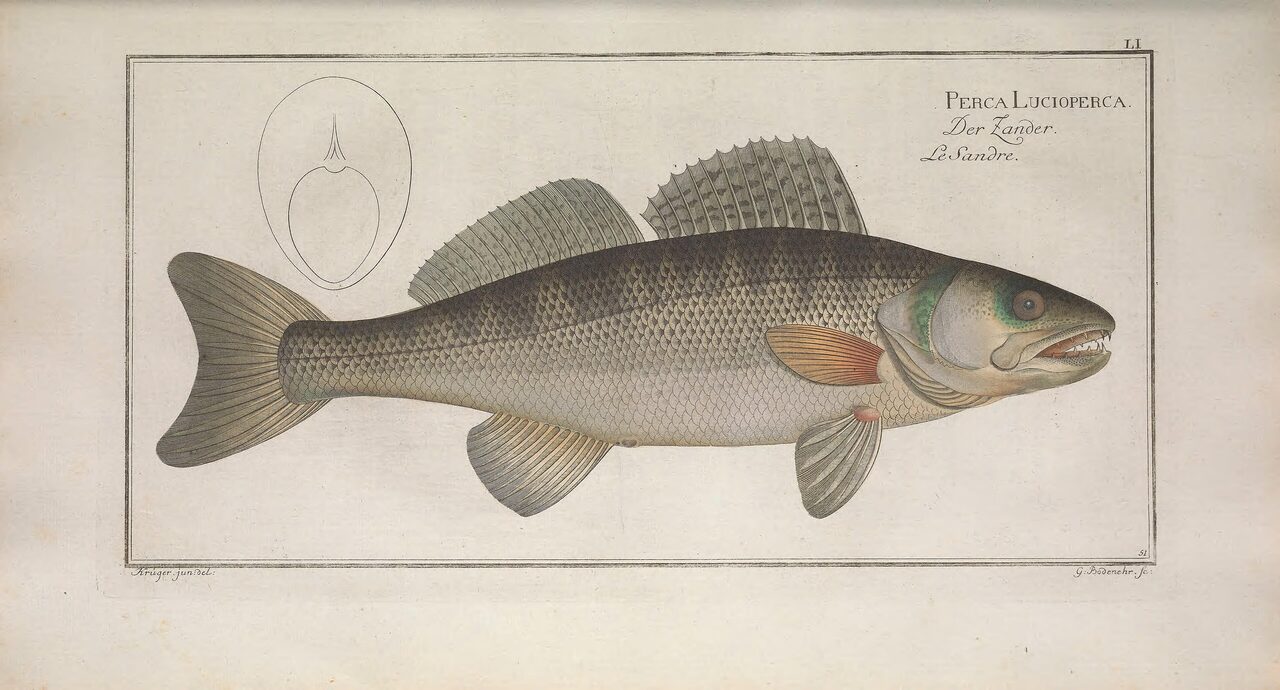
How to know it at once
- Fangs - several big, pointed catching teeth among small bristle teeth. No other native perch relative has them. The safest sign.
- Glass eyes - large, cloudy-silver, mirror-bright eyes for hunting in the half-light.
- Two separate dorsal fins with rows of dark dots on the back and tail fin.
- Slim body, faint bars - brassy-silver flanks, no red fins; the bars fade in old fish.
The zander is the largest native member of the perch family and a sleek, elegant predator. In the Franconian Saale it holds where the river slows and deepens: the impounded and mouth reaches, deep pools and current edges of the lower course, above all the calm, up to roughly five-metre-deep water behind the Gräfendorf weir.
Unlike the ambush-hunting pike, the zander chases in the open, close to the bottom and often in loose groups. It comes alive when the light fades and the water clouds, exactly when its glass eyes give it the upper hand.
- big fangs
- slim, long body
- no red fins, no blotch
- no fangs
- stocky, high-backed
- red fins, dark blotch
Rule of thumb: fangs and a slim body mean zander, not perch. And a duck-billed snout with a single rear dorsal fin means pike.
The gaze that sees in the dark
The zander's greatest gift lies in its eyes. Behind the retina sits a mirror-like layer, the tapetum lucidum, that throws stray light back through the eye a second time. It is a living night-vision device, and it is the reason the zander owns the murky, half-lit water where other fish are all but blind.
What makes the zander special (here)
The Saale near Gräfendorf holds proper zander: a memorable fish of around 90 centimetres and close to six kilograms once came from these deep, quiet reaches - the sort of catch anglers still talk about.
The zander is one of the few predators that readily eat the introduced round goby, and so it counts among the natural brakes on that fast-spreading newcomer - a quiet service to the river's balance.
Gräfendorf is fond enough of the fish to have given it a monument: a chainsaw sculpture over five metres tall, crowned by a rotating zander carved from larch that weighs some 125 kilograms, with a perch and whitefish below.
The zander stays part of the Saale because people help: each spring the local fishers release young zander of a hand's length, patient work that lets the slender predator grow slowly to the 50-centimetre mark.
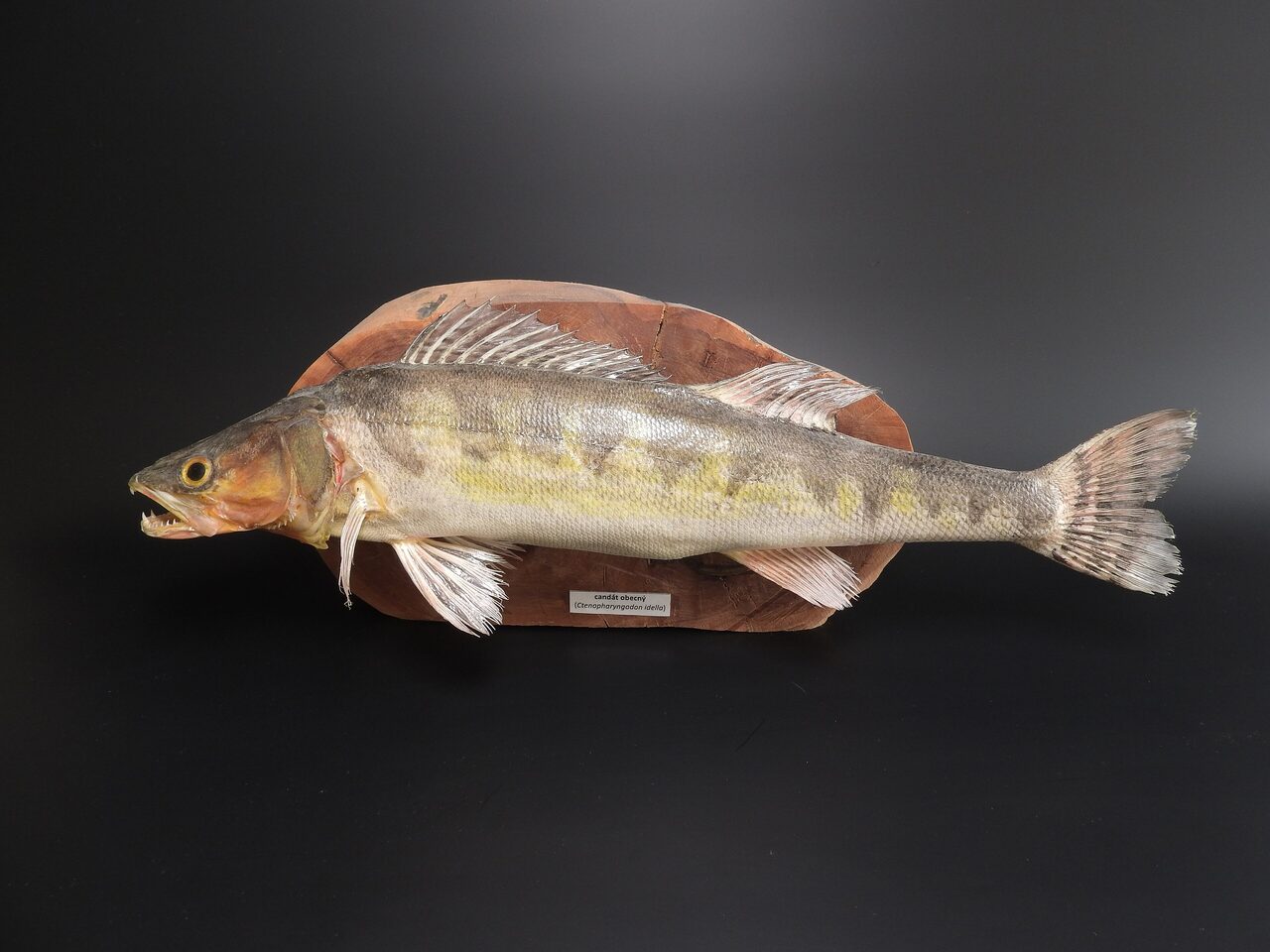
Where the Saale zander really comes from
As much as it belongs to the Saale today, its story here is young: across much of Germany the zander is no original native at all.
Its natural range reached only as far as the Elbe and the Danube. The Rhine system, and with it the Main and its Franconian Saale, lay just beyond that old frontier. Only from the late 19th century did people carry it westward, through stocking, breeding trials and the canals that link Main and Danube.
How deeply that shaped the fish was shown in 2014 by a genetic study from the Leibniz Institute of Freshwater Ecology and Inland Fisheries in Berlin: Europe's zander trace back to three old lineages, from the Danube, the Elbe and the Oder. In the ancestral heartlands these lineages stayed apart; in the newly colonised rivers of the west they blended into a true melting pot, in the Main system with a recognisable Danube signature. So the zander that moves through the deep water at Gräfendorf is neither a separate subspecies nor a relict stock, but a young, human-mingled Franconian blend. That is exactly why patient stewardship still matters: what people once brought here, the river only keeps with human help.
In the research
The origin trail follows a genetic study: E. Eschbach et al., “Population differentiation of zander (Sander lucioperca) across native and newly colonized ranges suggests increasing admixture in the course of an invasion”, Evolutionary Applications 7 (2014). Read the study
A guest that depends on us
The zander is not a fragile native but a naturalised guest, kept in the river by patient stocking rather than by natural spawning success. How it fares in a warming river is debated: some observe it feeling more at home in the Main, others that it copes poorly with warmth and falling oxygen. Predation by birds such as the cormorant is sometimes raised too, though it is fairly seen as one factor among several, not the whole story. What is clear is simple: respect the 50-centimetre size, keep to the closed season, and take with a measure.
Biological and legal notes are a research draft; binding are the current ordinance and your permit. Rules & closed seasons.
In the kitchen
White, lean, firm and mild flesh, and free of the pike's forked Y-bones, so it fillets easily - a true delicacy. Classically the fillet is fried crisp on the skin, but it is just as good grilled, steamed or baked under a salt crust.
How to fish it: close to the bottom with a slim soft plastic on a jig head, on a drop-shot rig, or with bait fish at night - worked slowly along current edges and deep pools, best at dusk and in turbid water.
From striped juvenile to glass-eyed hunter
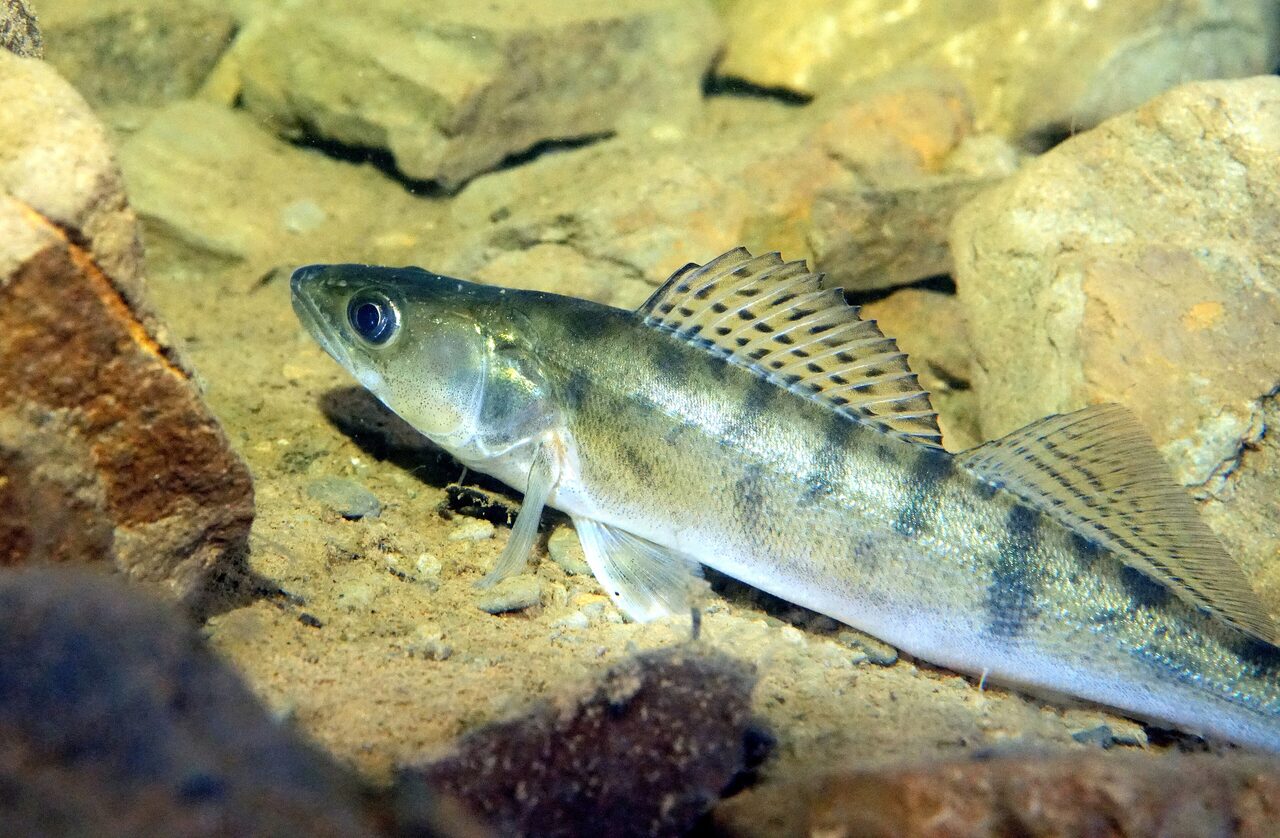
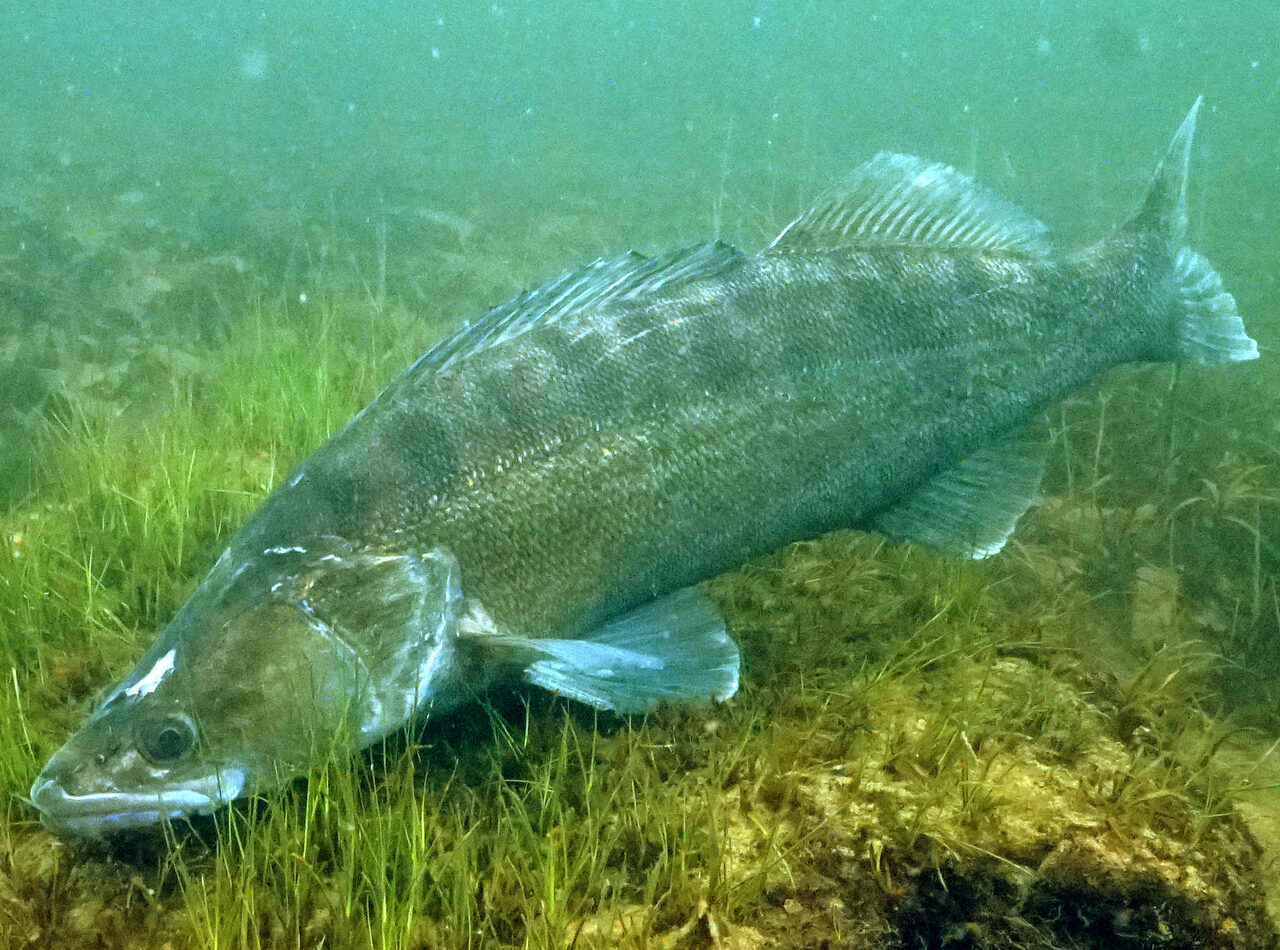
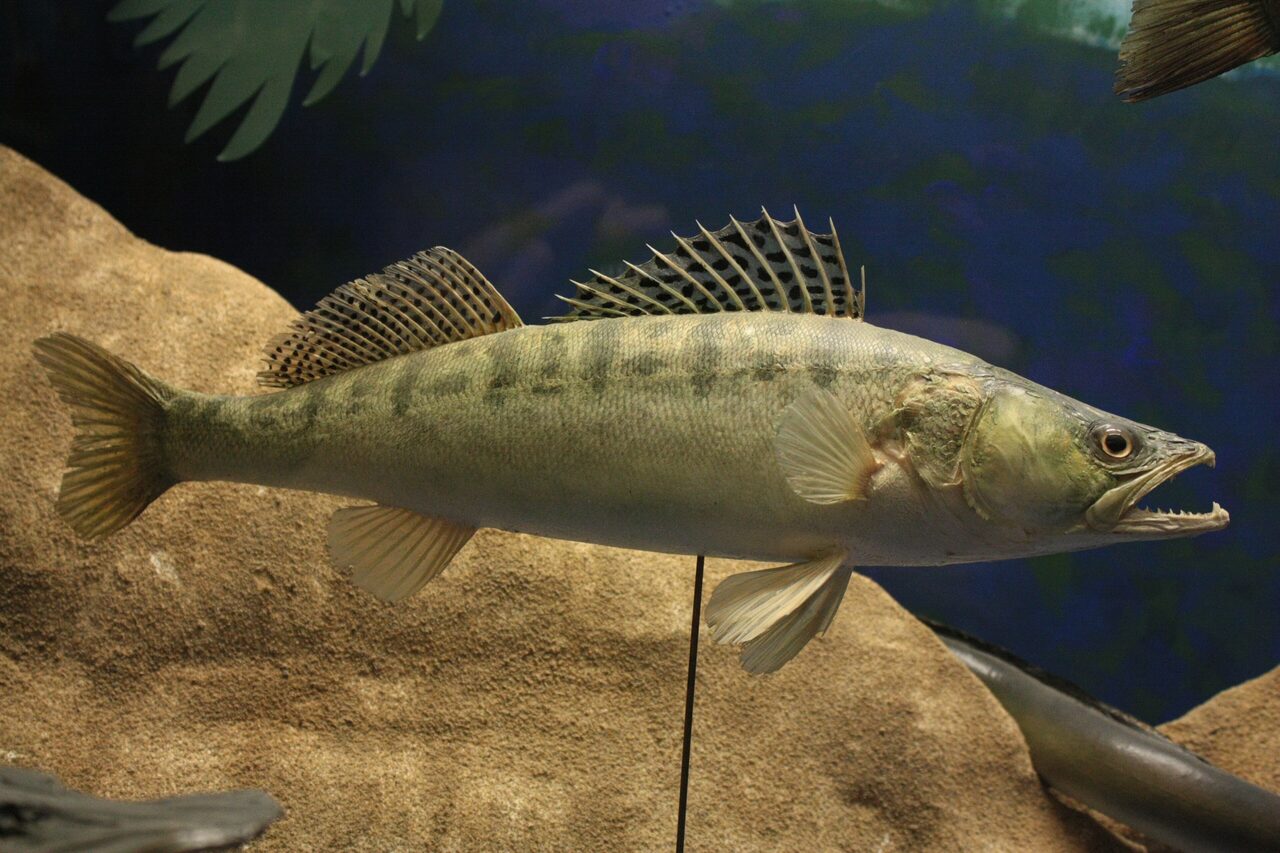
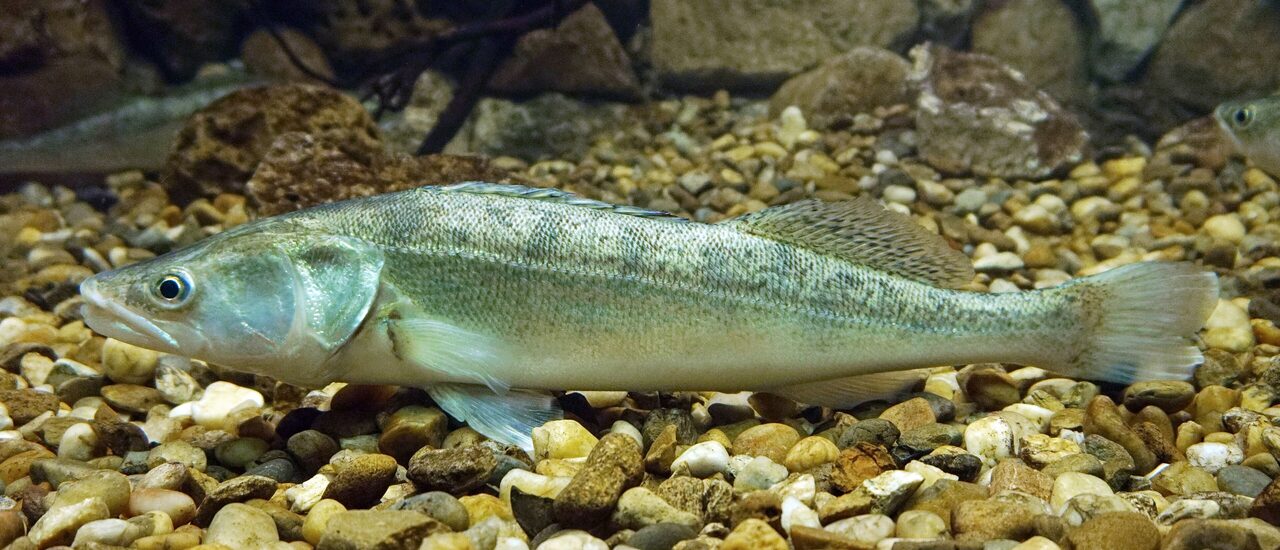
Photo credits: Lorenz Seebauer (CC BY-SA 4.0) · Lorenz Seebauer (CC BY-SA 4.0) · Tylwyth Eldar (CC BY-SA 4.0) · Tiia Monto (CC BY-SA 4.0)
Common questions about the zander
How do I recognise a zander for sure?
By three things together: several big, pointed fangs among smaller bristle teeth, large, cloudy-silver mirror eyes, and a slim, spindle-shaped body with two clearly separate dorsal fins and rows of dark dots on the back and tail fin. Teeth, eyes, dots - that trio settles it.
Zander or perch?
The perch is stocky and high-backed, wears bold red and orange fins and keeps a dark blotch at the rear of its first dorsal fin, and it has no fangs. The zander is long and slender, has no red fins, no blotch, but unmistakable fangs. Its faint bars fade with age; the perch keeps its bold ones for life.
Why do a zander's eyes shine like glass?
Behind the retina lies a mirror-like layer, the tapetum lucidum, a kind of built-in light amplifier. It lets the zander see when its prey can barely see at all, which is exactly why it hunts best at dusk, at night and in cloudy water.
Where does the zander hold in the Franconian Saale?
In the deep, calm, slightly turbid stretches of the lower river: the impounded and mouth reaches, deep pools and current edges. The up to roughly five-metre-deep impoundment above the Gräfendorf weir is exactly the kind of water a zander likes.
Is the zander really at home here?
It is a naturalised guest that the river now relies on people to keep: because it grows slowly to the 50-centimetre minimum, the local fishers release young zander year after year, so the slender predator stays part of the Saale.
Why is the zander such a prized food fish?
Because its flesh is white, lean, firm and mild, and because - unlike the pike - it carries no forked Y-bones in the back muscle, so it is easy to fillet. That is what makes it a favourite of fine kitchens.
Fish this stretch of the Saale
For the water at Wolfsmünster and Gräfendorf there are guest cards from a day ticket to a season permit, entirely without club membership.