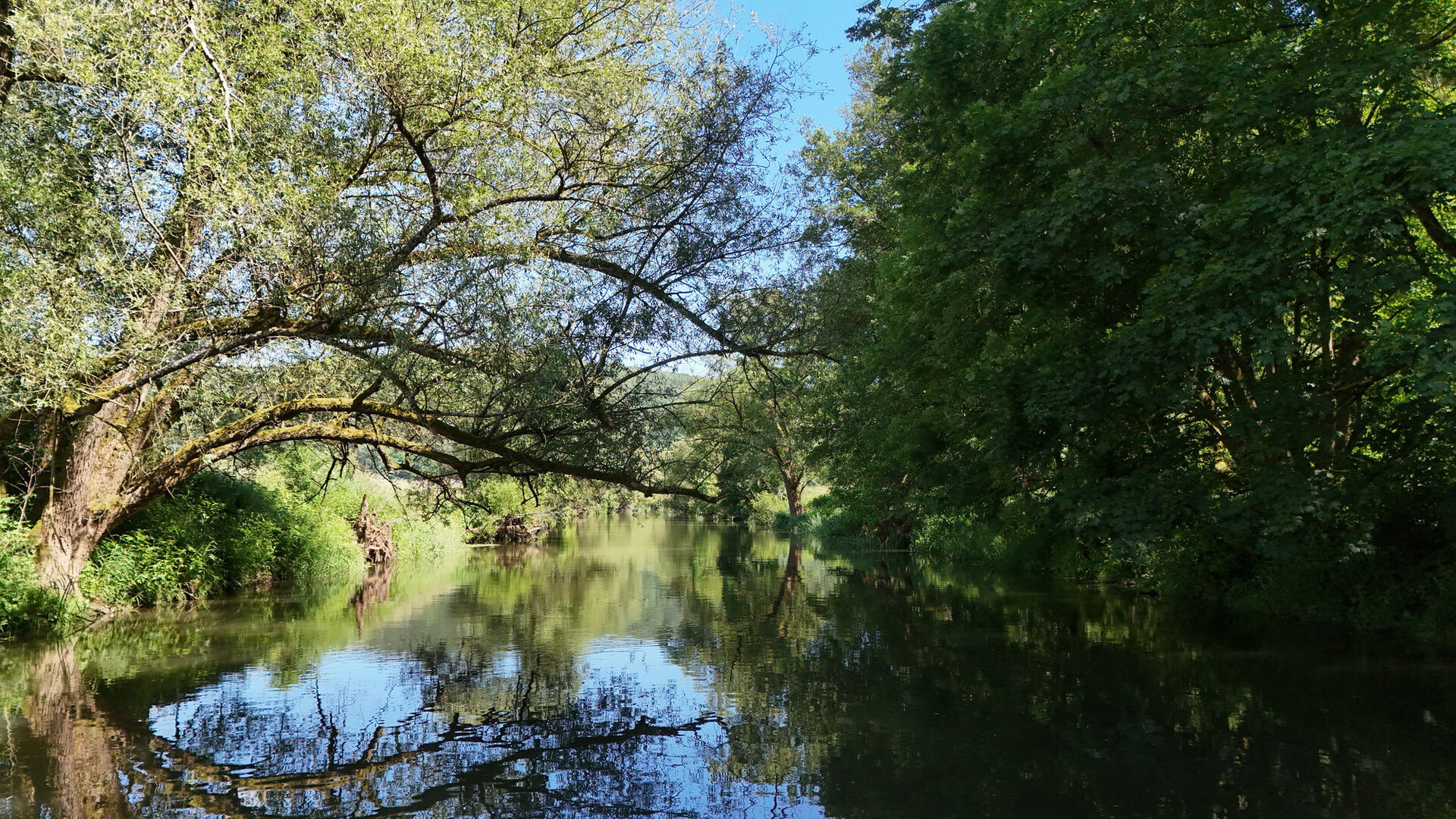
Who tends the Saale
An angling card is only the visible end of something older and quieter: a community that owns the fishing rights to this river and gives back to it. That community is us. Here we tell how we tend the water of the lower Saale - and what „Hege“ really means.
One river, shared by two stewards
The lower Saale is not tended by one body but by two, meeting at Schönau. Above lies our own long reach as the Hegefischereigenossenschaft; below, down to the mouth at Gemünden, the centuries-old Fischerzunft Gemünden holds the right.
- Weickersgrüben
- Roßmühle
- Michelau
- Gräfendorf
- Schonderfeld
- Wolfsmünster
- Schönau
- Gemünden
What a Hegefischereigenossenschaft is
It sounds like a mouthful, and it is a very German thing. A Hegefischereigenossenschaft is a cooperative under public law that pools the fishing rights of a stretch of water. Its members are not the anglers - they are the owners of the river banks and beds, or those who lease them. Together they answer for one thing above all: the health of the water.
„Hege“ is the old word for that duty of care: to give back to the water what fishing takes from it. In practice that means stocking native fish, keeping the river passable, protecting spawning grounds - and speaking for the river when authorities decide its future. Our neighbouring cooperatives show the scale of the tradition: several on the Saale system are now a century old.
Our cooperative in figures
- Legal form
- public-law cooperative
- Reach
- approx. 17.5 km
- Impounded sections
- three, set by weirs
- Members
- owners & lessees of the water
- Partner club
- ASC Forelle Gräfendorf
- Hatchery
- Fischgut Seewiese
- Meeting place
- Wolfsmünster
- Below Schönau
- Fischerzunft Gemünden (1567)
Caring for the water, in practice
Stock & tend
We restock native fish to an official plan, agreed with the Lower Franconia district fisheries advisory.
- Stocking to an official plan
- Focus: bringing the grayling back
- Native brown trout, nase & eel
Room & structure
A straightened river is a poorer one. We work to give the Saale back its bends and gravel.
- „Alte Saale“ meander reopened
- Three groyne fields
- Spawning sanctuary designated
Rights & voice
Keeping the cadastre of fishing rights in order - and standing up for the river before the authorities.
- Maintain the fishing cadastre
- Update the management plan
- A voice toward the authorities
How the Saale renewed itself
A quiet turn over two decades - from a filled-in loop to a passable, planned-for river.
-
2001
The „Alte Saale“ is set free
A river loop cut off in an old land consolidation is reopened over roughly 500 metres - new nursery water for young fish.
-
2002
A plan for the river
The cooperative commissions an ecological management plan and sets about putting the cadastre of fishing rights back in order.
-
2003
Ecological management plan
The plan is presented together with the EU-funded river-development scheme - the guideline for the cooperative's work.
-
2004
The weir becomes passable
A fish ladder and bypass channel at the Gräfendorf weir let fish run up from the Main again.
-
2007
The grayling returns - and a new hand on the tiller
The first hatchery-reared grayling go back into the Saale. In Wolfsmünster, Sabine Töpfer-Gebert is elected - the first woman to chair a Lower Franconian Hegefischereigenossenschaft - succeeding the long-serving Kurt Dietl.
-
Today
Tending, season after season
Stocking by plan, weirs kept passable, spawning grounds watched - the quiet work goes on.
Bringing the grayling back
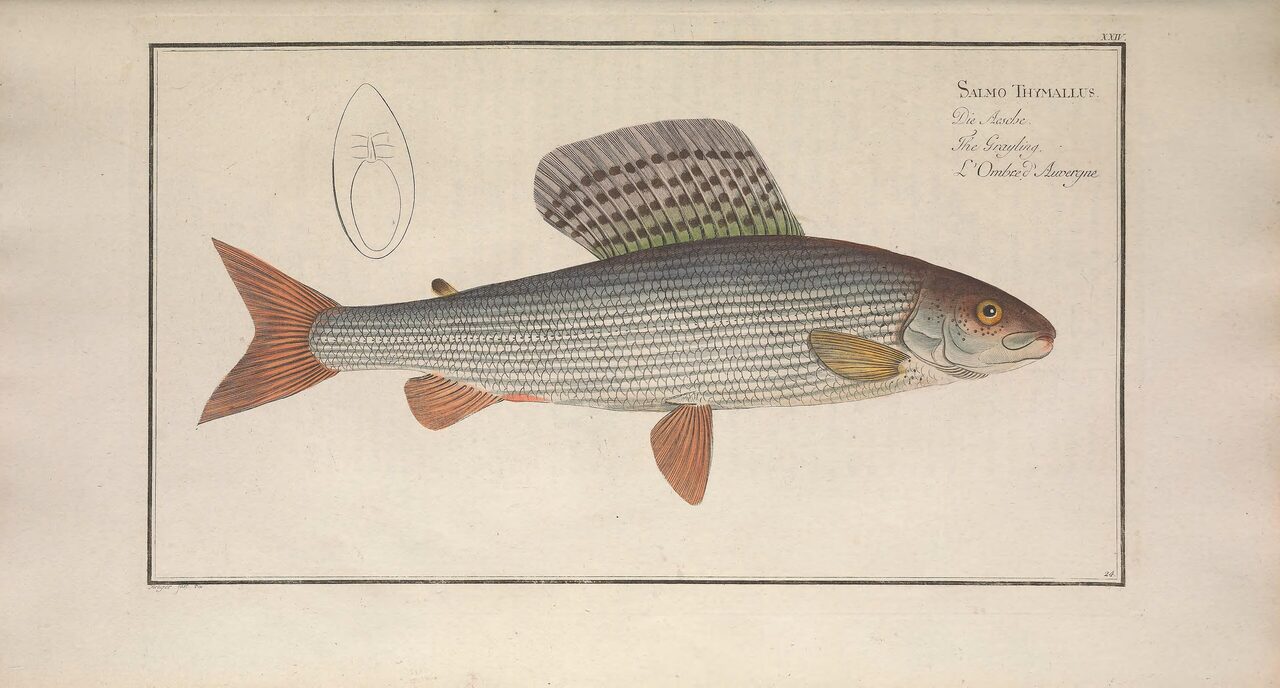
Around Wolfsmünster the Saale was once a famous grayling water, drawing fly-fishers from far away. Then, over a few hard winters, the stock all but collapsed - and a fish that asks for the cleanest, liveliest water nearly vanished from the lower river.
So we rebuild it the slow, regional way: parent fish are taken from the Schondra, the Saale's own tributary, so the strain stays genetically at home; their eggs are reared at the Fischgut Seewiese - one of the oldest trout hatcheries still working in Germany - and hatched in brood boxes set right in the home water, before the young grayling go into the Saale. Hand in hand with the ASC Forelle Gräfendorf and the Lower Franconia fisheries advisory.
In 2007 the work paid off: 4,444 young grayling went into the Saale at Schonderfeld, and in 2010 Bavarian television even filmed a release for the „Frankenschau“. „Fische haben keine Lobby“ - fish have no lobby - the long-serving chair Kurt Dietl liked to say. That sentence is exactly what we work against.
Two papers, and a few good habits
To fish here you need two things: the state fishing licence (Fischereischein) and an angling permit (Erlaubnisschein) for the stretch you want to fish. The permit is your share in the cooperative's care for the water - its fee flows back into stocking and habitat.
Closed seasons and minimum sizes protect fish while they spawn. The table shows a few that matter on this water; the full, binding list lives on the Rules page.
| Rule | On this water |
|---|---|
| Licence + permit | both required |
| Minimum size, trout | 26 cm |
| Night fishing | not allowed in the Gemünden guild reach |
| District ordinance | renewed for 2026 |
Excerpt. Exact rules can differ by stretch; the Rules page is binding.
Become part of the care
Every permit helps the Saale: it pays for stocking, for spawning grounds, for a river kept passable. Pick your stretch - and fish a water we look after.