The cradle of the trout

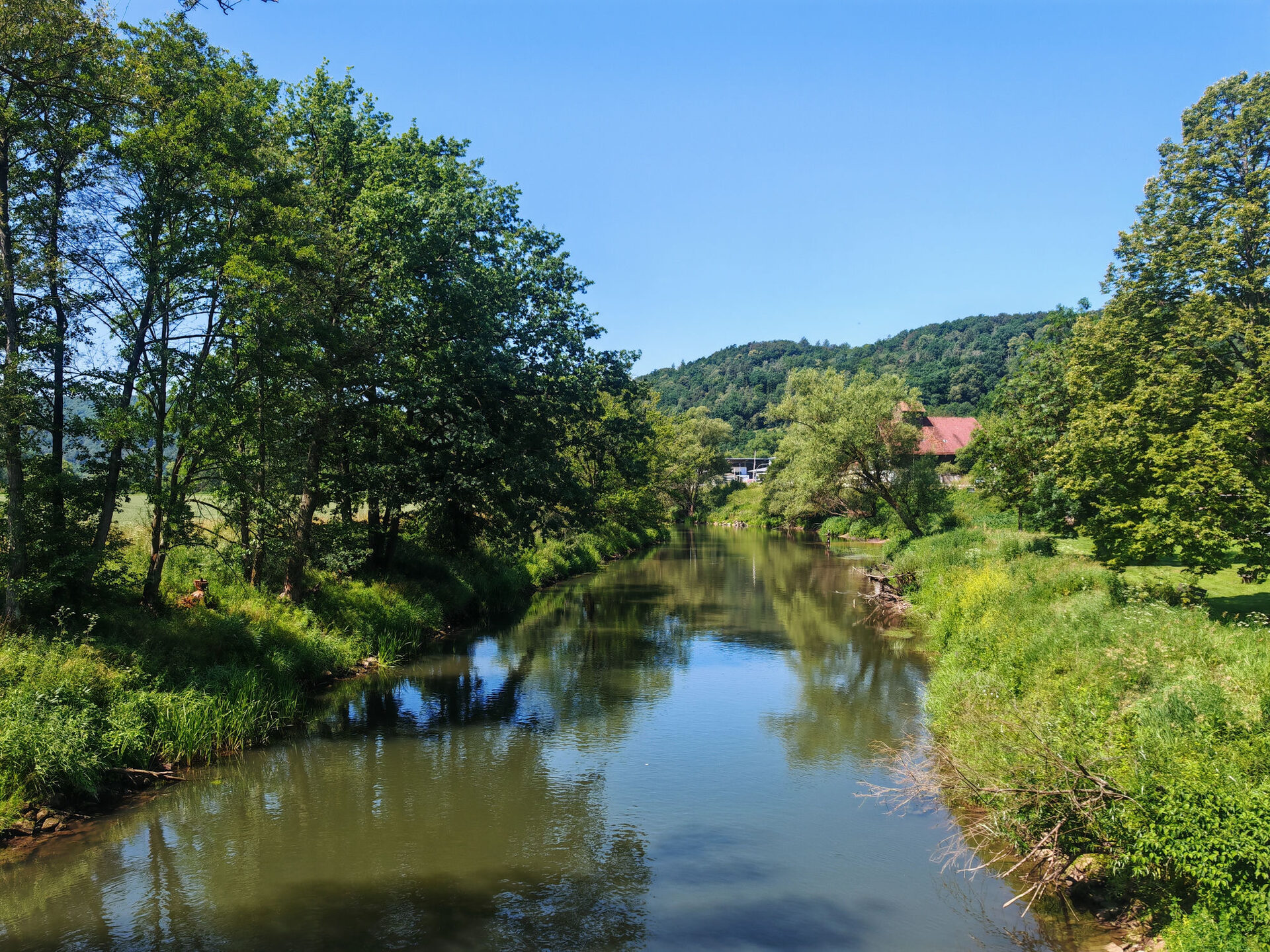
Opposite Schonderfeld, on the Fischbach in the Saale valley, a trout farm has raised its fish since 1882 - one of the oldest, if not the oldest, in Germany. Its story runs from a Würzburg lawyer and its own railway halt to the Thurn family, who keep the farm today as a sideline - and to a quiet nursery for grayling and the freshwater pearl mussel.

At a glance

The farm in brief

A working trout farm and a piece of living regional history - terraced ponds fed by a cold spring, in a side valley of the Franconian Saale between Spessart and Rhön.

The claim of being „Germany's oldest trout farm“ is one the sources themselves soften to „one of the oldest, if not the oldest“ - and even so told, it is a remarkable story.

Fischgut Seewiese

Founded
1882 · Friedrich Zenk
Location
opposite Schonderfeld, on the Fischbach (Gräfendorf)
Water
Ochsenquelle spring · ~9 °C
Today
the Thurn family · a sideline
Ponds
28 natural ponds, terraced
Species
brown & rainbow trout, char
Sold
monthly · Gemünden market · village shop
1882 · the founder

A lawyer with a passion for trout

The farm was built by Friedrich Zenk, a Würzburg lawyer and military judge (Auditeur) who chaired the Lower Franconian district fishing association and was remembered as a „trout breeder out of passion“. As early as 1878 he had published a guide to artificial trout breeding, hoping to restock „the mostly impoverished streams of Lower Franconia, of the Spessart and the Rhön“ with fine fish.

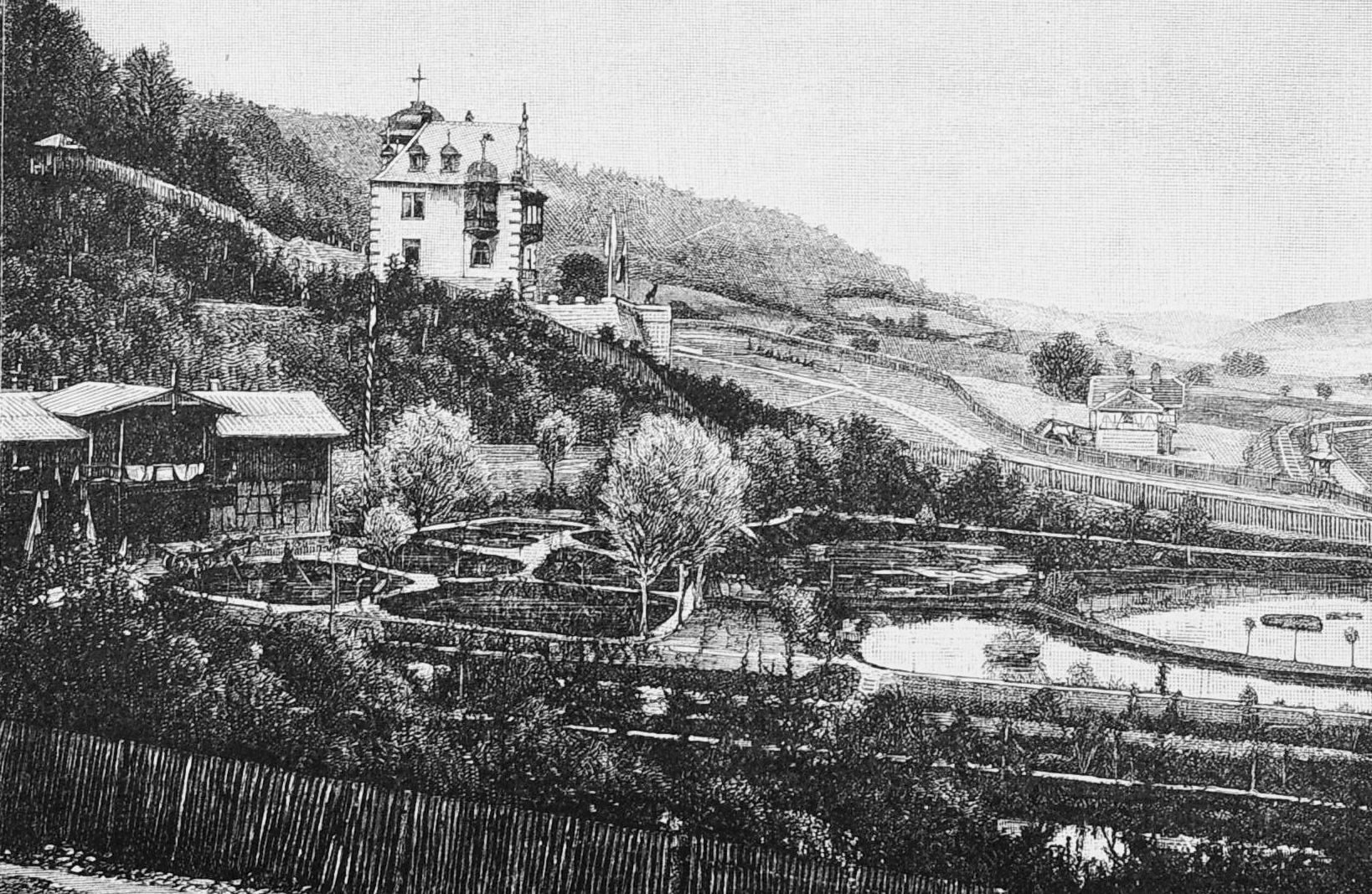
In 1882 he bought the fishing right on the Fischbach - the boundary stream between Gräfendorf and Schonderfeld - for 40 marks, together with meadows at the Seewiese. On some seven hectares he laid out sixteen ponds, fed by spring or brook water, and in their midst a 33-metre hatching house with breeding tables of charred fir wood, over which fresh water ran continuously.

The Seewiese fish farm around 1892, a historical view from the „Die Gartenlaube“ magazine
The farm around 1892
Around 1892 · the heyday

From the Saale out into the world

By around 1892 the farm - which had its own railway halt - was shipping some two million iced fish eggs a year, packed in cotton wool or moss, and about a million young fish, across Europe and even overseas, alongside some 30 hundredweight of table fish. „In Chancellor Bismarck's day“, a later report recalled, young fish travelled „in special barrels as far as England and Russia“.

Bred here were above all salmonids: brown trout, char, Rhine salmon, lake trout, rainbow trout, the Scottish Loch Leven trout and the grayling. The Seewiese showed itself internationally early on: in July 1883 Zenk presented it in London's Royal Albert Hall, and the family still keeps diplomas of honour - Bonn 1883, Munich 1885, the „Salmonids and Carp“ exhibition in Würzburg 1905.

In the founding years, so the accounts go, even Chancellor Otto von Bismarck and the Bavarian Prince Regent Luitpold are said to have come to see the new breeding methods for themselves. By one account the Seewiese may have been „the first place in Germany to breed trout in a hatching house“ - the root of its reputation as one of the oldest, if not the oldest, fish farm in the country.

1882 to today

A relay across seven owners

The farm changed hands often, yet the trout were always passed on. This chain follows the local history book by Johannes Sitter.

  1. 1882

    Friedrich Zenk

    The founder lays out ponds and hatching house and makes the Seewiese known far beyond Franconia. For health reasons he sells in 1889 - by then some 30 breeding ponds.

  2. 1889

    Von Derschau & Schellhorn-Wallbillich

    Two retired lieutenant-colonels. Von Derschau, head of the German Fisheries Association, is said to have travelled „to Norway for fish eggs“; Schellhorn, drawn by the hunting, builds the neighbouring hunting lodge in 1888/89.

  3. 1901

    The Hieke family

    The merchant Hans Hieke leases the farm from 1901 and owns it outright from 1911. After his early death his widow Paula runs it until 1955 - and leaves it „free of debt“.

  4. 1955

    Berndes & Erbes

    Marianne Berndes inherits the farm; Eduard and Katharina Erbes manage the by-then quiet estate until 1970.

  5. 1970

    Alois & Siglinde Heinlein

    A Frankfurt couple revive the deserted Seewiese: Alois, a keen angler, trains as a fish farmer, sells his haulage firm in 1975 - and chairs the Gräfendorf sports club for 25 years. From 1976 to 1993 the Heinleins also run the hunting lodge as a holiday hotel.

  6. ~1994

    Petra & Wolfgang Thurn

    Their daughter Petra and her husband Wolfgang take over the farm, which they still run today as a sideline.

  7. today

    The next generation

    Son Thorsten Thurn is a trained fish farmer - the craft stays in the family, ready to be passed on again.

The farm today

The Thurn family, at their own pace

Twenty-eight natural ponds lie terraced in a side valley of the Saale. „Natural pond“ means the fish are not fed every day but forage for themselves too. Brown and rainbow trout and char are the mainstay; in a reed pond stand „side fish“ - carp, zander, catfish, grass carp, whitefish and a single sturgeon.

Quality over speed: no fish are bought in, to keep disease at bay, and a table trout is ready only after three to four years - „colourings or other additives have no place in the feed“. Carp are a case apart, kept in the lower, warmer ponds and fed on grain from Schonderfeld farmers, so that in the clear spring water the fish does not taste „muddy“.

The greatest risk is the water itself. Drought and a weaker spring flow leave ponds unstocked. „A fish farm without water is hard to run“, says Petra Thurn.

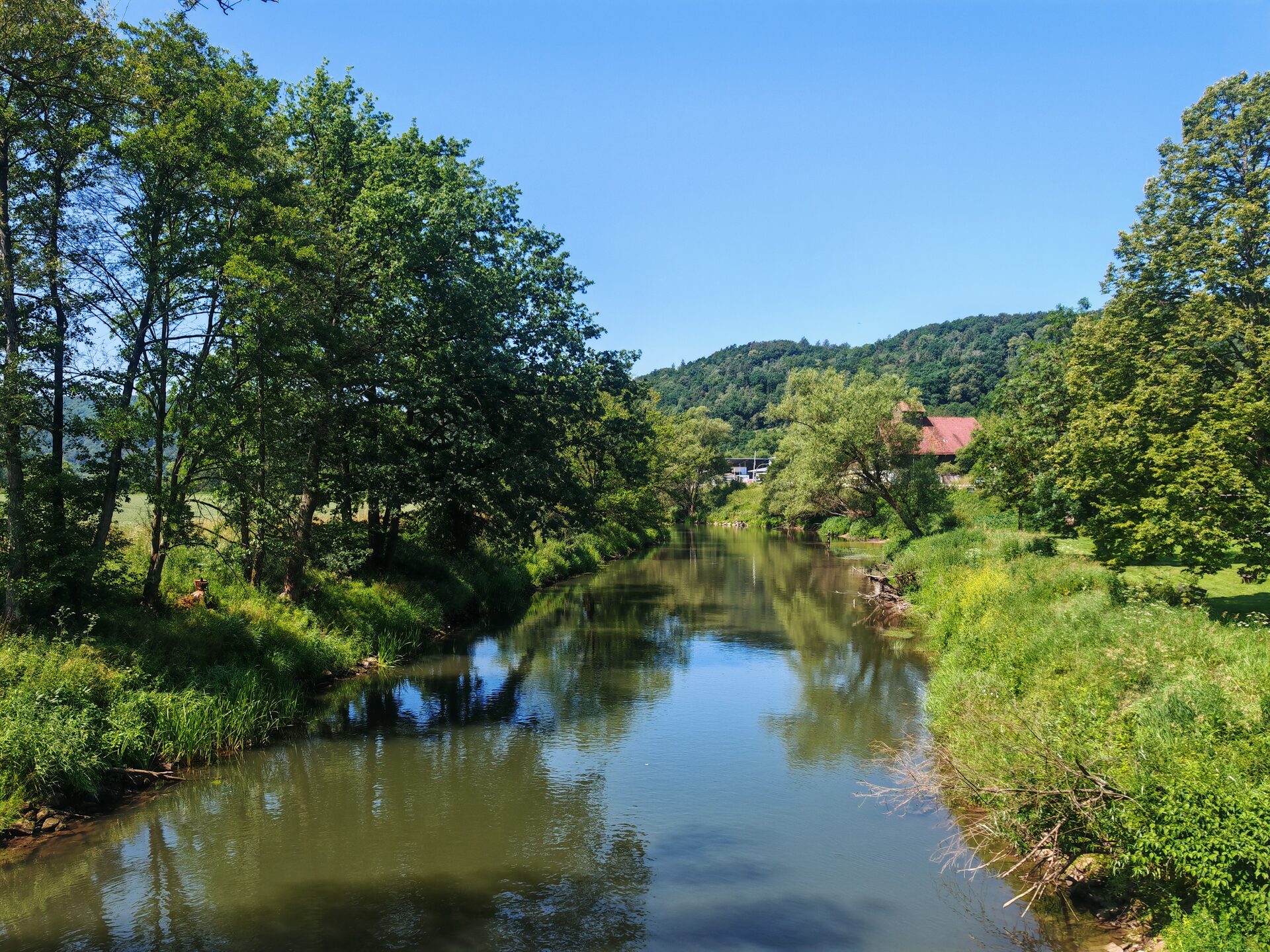
View from Gräfendorf down the Saale to where the Schondra joins it
Where the Schondra meets the Saale
The hatching house

A nursery ward for eggs

The heart of the farm is the winter hatching. From late December the eggs are „stripped“ from the mother fish; in a hatching cabinet about a metre high, up to half a million can be tended at once. Fresh water from the Ochsenquelle - „a pleasant nine degrees“ even in winter - flows through the stacked trays, where the eggs lie „like caviar“.

The enemy is fungus: infected eggs, pale instead of soft pink, are picked out „with a pipette or tweezers“, at least every other day. „Here it is as delicate as in a neonatal ward“, Thurn says, comparing his hatchery to „a hospital unit for premature babies“.

Newly hatched fry first get hand-fed „baby food“ - twelve hours a day, every hour - before automatic feeders take over; they grow on through the „summerling pond“, the kindergarten of the first summer. The scale has shrunk with the years: around 250,000 fish in 2004, „about half a million trout“ a year in 2006, and today only a small part still bred in-house.

Beyond the business

A nursery for river and fish

As one of the few places around with a hatching house and steady spring water, the Seewiese serves conservation too - for brown trout, grayling and the unique pearl mussel of the Schondra. These figures are the accounts of the clubs and agencies involved.

from 2005

Brood boxes for brown trout

with the HFG Untere Saale

Since 2005 the hegefischerei cooperative has let its young fish hatch close to home in brood boxes - shown the ropes by fish-farming master Wolfgang Thurn, with spawn from the Seewiese. That also meets the fisheries law's call for locally suited stock; in 2006 the cooperative took 20,000 eggs from Thurn's hatchery.
2007-2010

The grayling returns

HFG · ASC Forelle · Bezirk Unterfranken

For the return of the endangered grayling the farm raised the young: 4,444 grayling went into the Saale in 2007, over 1,000 in 2009 from Schondra parent stock (a genetically native strain), and in 2010 Bavarian television broadcast a release live in the „Frankenschau aktuell“. Partners: the HFG Untere Saale (Sabine Töpfer-Gebert), the ASC „Forelle“ Gräfendorf and the Lower Franconia fisheries advisory.

from 2000

Refuge for the pearl mussel

Schondra · Prof. Geist, TUM

The Schondra holds a globally unique freshwater pearl mussel; its larvae ripen in the gills of the brown trout. At the farm, trout are deliberately „infected“ in a round tank at lowered oxygen - and when the population crashed in 2013, the numbered mussels were placed „in the care of Wolfgang Thurn“. Prof. Jürgen Geist (TU Munich) found the population had the highest biomass among 20 European waters in 2005.

And the cormorant?

In the sources the fishery names the cormorant as the main reason for the grayling's decline, with feeding figures that are interested positions, not neutrally documented facts. The cormorant is a protected, native bird. The same sources give structural causes equal weight: the loss of river continuity, nutrient inputs, the plainness of straightened channels and declining water quality.

How the river is tended  ·  More on the grayling

Custom & encounter

When the farm opens its gates

Again and again the „oldest trout farm in Germany“ has been a stop on the „Saale-Musicum“ cultural project, offering „a look behind the scenes“ with hourly tours and fish „smoked and baked“. At its farm festivals and „open estate“ days the Thurns throw the gates open: tours, trout dishes in every variation, a raft ride on a pond, a play street and „angling (without hooks)“ for children - and, in 2010, „angling in the trout pond“. The Spessart hiking club, too, made the farm a walking destination.

From the cook's kitchen come a trout cocktail, trout „meunière style“ and, for New Year's Eve, „carp blue“. The idyllic grounds keep a small menagerie - Cameroon sheep, geese, miniature pigs „Wutschi and Regina“ - and in 2006 even a beaver („Dicker“) settled by the drive, left in peace by the Thurns.

Such openings are occasions, not fixed dates - if you would like to visit, it is best to ask ahead.

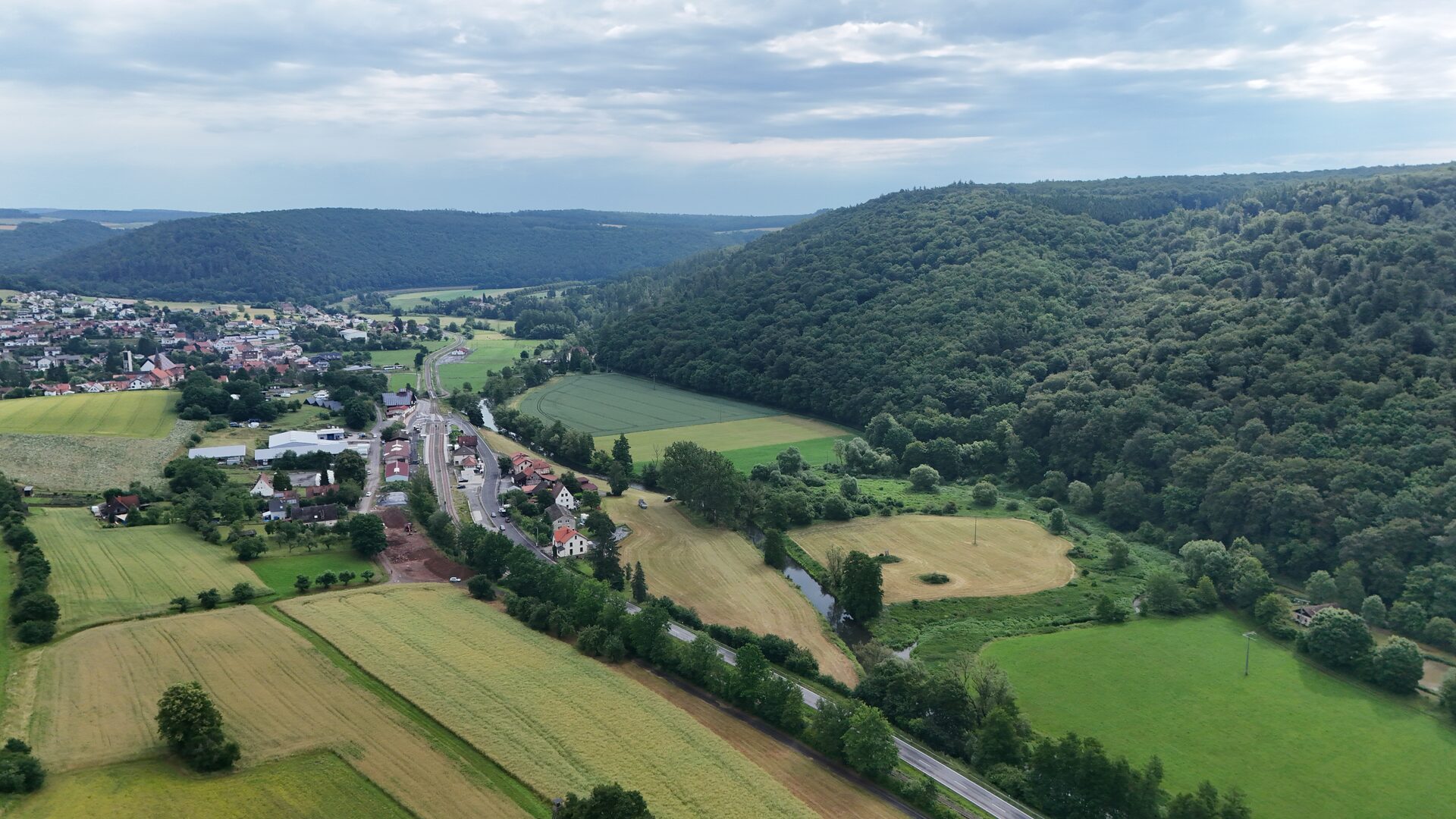
Gräfendorf on the Franconian Saale, home municipality of the fish farm
Gräfendorf on the Saale
Book & sources

The farm and its pioneers, on paper

The farm's history was worked up by the former Gräfendorf mayor and district councillor Johannes Sitter in his book „Fischgut Seewiese und seine Pioniere“ (2021, 96 pages in A4, with photographs, old newspaper articles and documents, and guest contributions by Willi Dürrnagel and Michael Fillies). The spur was a planned television piece by Bavarian broadcasting („Zwischen Spessart und Karwendel“); the Thurn and Heinlein families handed Sitter „two bulging folders“ of records. The book was presented on 15 November 2021 in the „Saalestuben“ at Michelau.

On the sources: this page gathers what the archive of the regional Main-Post newspaper (2000-2022) tells about the farm - journalistic accounts and material supplied by the business, not official primary sources; many historical details follow Sitter's local history book. The superlative „oldest fish farm in Germany“ is softened by the sources themselves to „one of the oldest, if not the oldest“; Zenk's origins and the Bismarck anecdote are uncertain.

Visiting & angling

Around the fish farm

The Fischgut Seewiese is also an outlet for the fishing permits on this stretch (Seewiesenstraße 3, tel. 09357 223); next door, Siglinde Heinlein (Seewiesenstraße 2) issues permits too. Fresh and smoked fish is sold once a month straight from the farm, at the Gemünden farmers' market and in the Gräfendorf village shop „Unser Lädle“.

Permits & outlets How the river is tended History on the river