Bavaria named the grayling Fish of the Year 2026 - a symbol of clean, oxygen-rich, living water.
Plate II · leading fish of clean water
Grayling
Thymallus thymallus
Fish of the Year 2026 Bayern
Closed season
1 January – 30 April
J
F
M
A
M
J
J
A
S
O
N
D
Minimum size
0
30
60
90
120
min. 35 cm
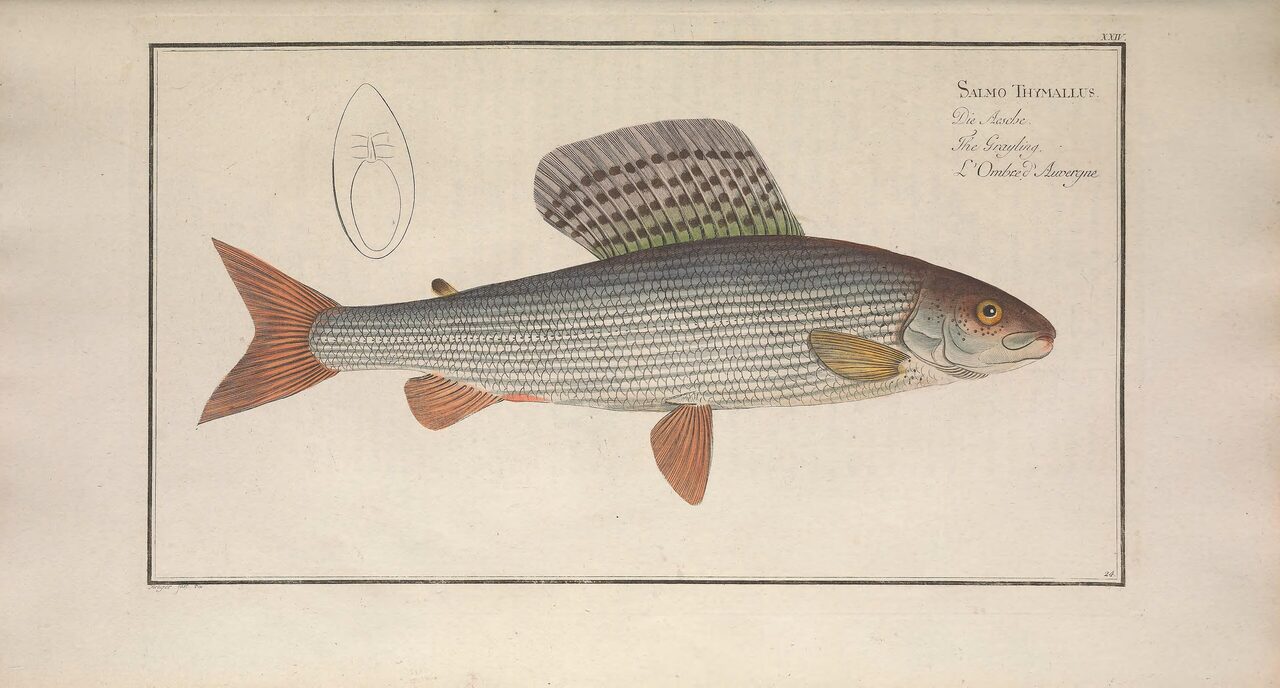
How to know it at once
- The grayling flag - a tall, striped, sail-like dorsal fin. No other fish of the Saale has one. The safest sign.
- Adipose fin - the small, rayless fin before the tail marks it as a salmonid.
- Small, slightly underslung mouth - built for insects, not for hunting fish.
- Large scales, few spots on the silvery, brassy-shimmering flanks.
Character & habitat
The grayling is an elegant salmonid and the fish that gives the „grayling zone“ its name: clear, cool, oxygen-rich rivers over gravel - exactly the character of the Franconian Saale. It likes to hold in open current, reading the drift for food, and spawns over shallow gravel in spring.
As Bavaria's Fish of the Year 2026 she stands for clean water and living rivers - where the grayling thrives, the river is in good health.
Not a trout
Grayling
- tall striped flag fin
- small, underslung mouth
- few spots, large scales
Trout
- small, plain dorsal fin
- large, terminal, toothed mouth
- boldly spotted body
One glance at the dorsal fin settles it: the flag means grayling.
Almost lost, brought back
The return of the grayling
Into the 1990s the Saale around Wolfsmünster was a first-rate grayling water. Then the stock collapsed. Ever since, anglers, the cooperative and the Seewiese fish farm have been bringing the grayling back - with eggs from the Schondra, so the young fish belong to their home water from the very first day.
4444
young grayling were released into the Saale meander near Schonderfeld in the peak year of 2007 - a high point of the local breeding programme, and proof that patient work pays off.
The grayling & the Saale
What makes the grayling special (here)
Freshly caught, the grayling smells faintly of thyme - which is exactly how it earned its scientific name, Thymallus.
Fly fishing has deep roots here: Wolfram von Eschenbach already wrote of catching grayling with the feather hook, and the region's first fly-fishing meeting was held in Gräfendorf.
A full-grown grayling of around 50 centimetres already tips the scales at over a kilogram.
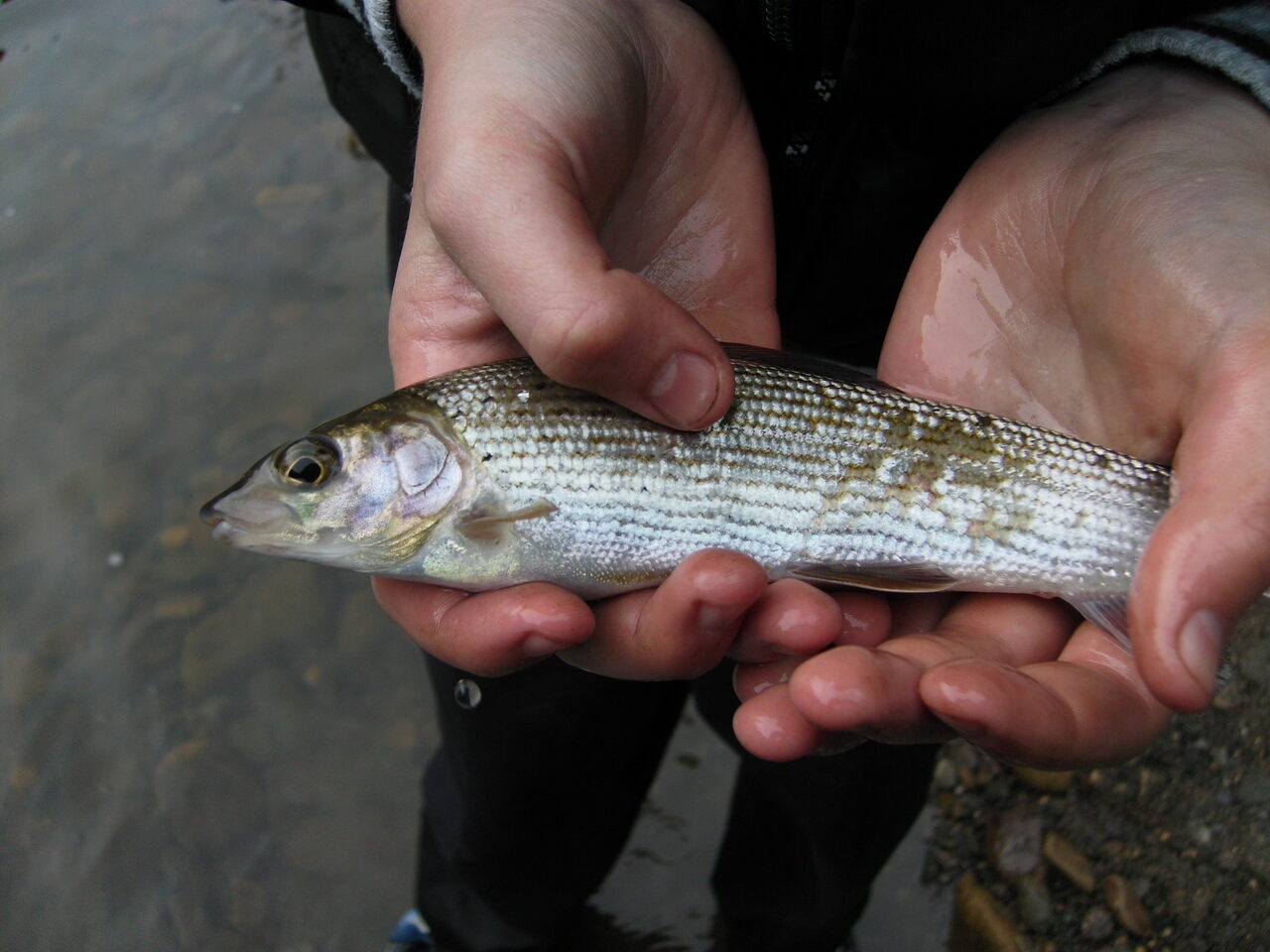
The living fish
The flag for real
The old engraving only hints at it; here you can see it properly - the tall, striped dorsal fin that the grayling raises like a sail, and that no other fish of the Saale carries.
Catch report 2025
3
grayling reported
25 cm
smallest fish
42 cm
biggest fish
35 cm
average size
A measure of clean water
Demanding - and worth the effort
The grayling is on the Red List. It reacts sensitively to warmer water, dammed rivers and silted spawning gravel, and predation takes its toll too - a hard truth ever since the winter of 1996/97. Because she asks so much of a river, her presence is a badge of honour for a healthy one, and that is exactly why so much care goes into bringing her back.
Biological and legal notes are a research draft; binding are the current ordinance and your permit. Rules & closed seasons.
In the kitchen
Tender, mild, white flesh - a true delicacy, classically fried in butter, and best eaten very fresh. But given how threatened she is, admiring and releasing her is often the finer choice.
How to fish it: the fly is the classic - a small dry fly or nymph on a fine tippet, drift-free in the current. Autumn is the prime time.
Good to know
Common questions about the grayling
Why is the grayling called Thymallus?
Because when freshly caught it gives off a faint scent of thyme. The old naturalists noticed it and named the fish after the herb - Thymallus.
How do I recognise a grayling for sure?
By its large, striped, sail-like dorsal fin - the grayling flag. No other fish of the Saale has one. Add the small adipose fin and the small, slightly underslung mouth and it is unmistakable.
Why has the grayling become so rare?
It needs clean, cool, oxygen-rich water and gravel to spawn on. Warming, dammed rivers, silted gravel beds and predation all weigh on it; after the hard winter of 1996/97 the local stock collapsed.
What is being done for it here?
Anglers, the fishery cooperative and the Seewiese fish farm breed grayling from local Schondra eggs and release the young into the river - 4,444 in the peak year of 2007 - so the fish stay genetically at home.
How do you fish for grayling?
Classically with the fly: a small dry fly or nymph on a fine tippet, because of the grayling's small mouth. Autumn is the prime season. Given how threatened it is, gentle handling and release are often the better choice.
Since when has the fly been used here?
A very long time. Even Wolfram von Eschenbach, around 1200, wrote of catching grayling with the feather hook - and the region's first fly-fishing meeting was held in Gräfendorf.
Fancy a cast?
Fish this stretch of the Saale
For the water at Wolfsmünster and Gräfendorf there are guest cards from a day ticket to a season permit, entirely without club membership.