In our stretch the eel lands on the hook more often than almost any other fish - it regularly tops the local catch lists.
Plate I · nocturnal migratory fish
Eel
Anguilla anguilla
Closed season
1 October – 31 December
J
F
M
A
M
J
J
A
S
O
N
D
Minimum size
0
30
60
90
120
min. 50 cm
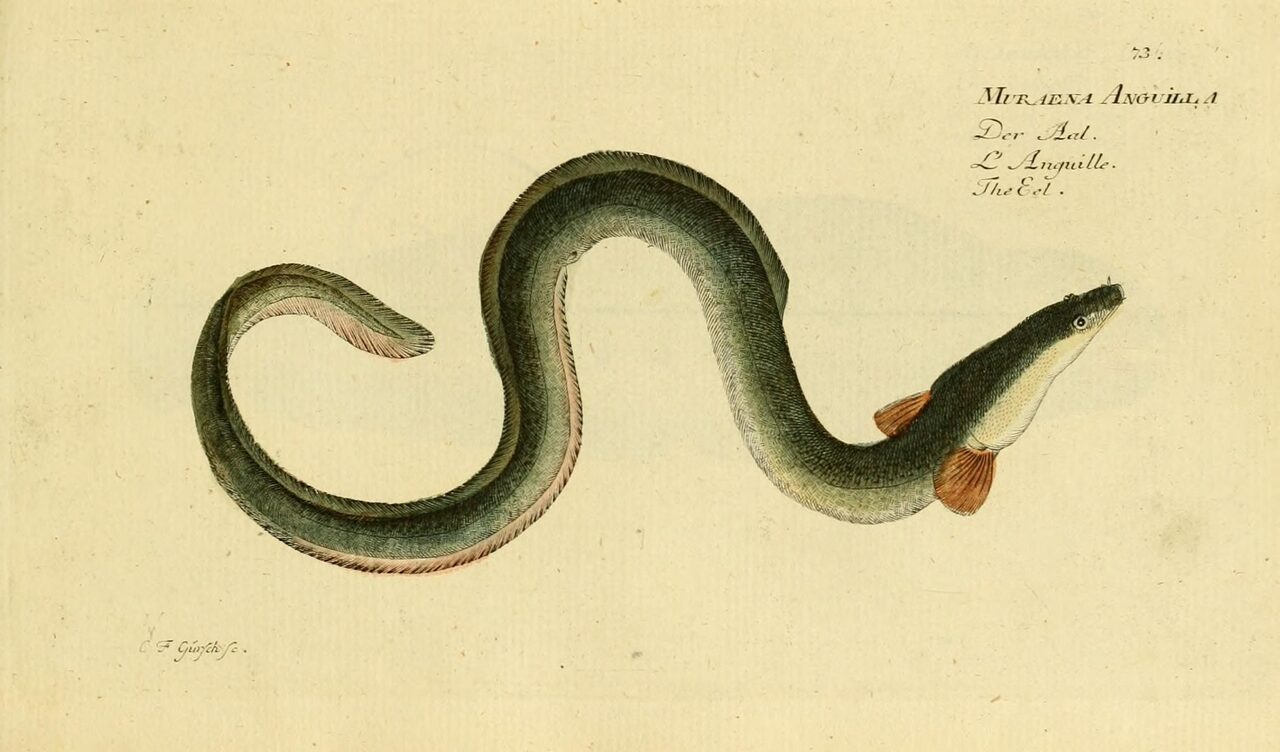
How to know it at once
- Continuous fin seam - dorsal, tail and anal fin merge into one seam; no separate tail fin. The safest sign.
- Round, snake-like body with almost scaleless, very slimy skin.
- Two small pectoral fins, no pelvic fins right behind the head.
- Colour by stage - yellowish belly (yellow eel) to silvery-white (silver eel, before migration).
Character & habitat
The eel is a nocturnal bottom fish with a snake-like body. In the Franconian Saale it holds in the calm, structure-rich spots: riprap and groynes, roots and deadwood, quiet pools behind obstacles, weirs and bridges. By day it hides in the substrate; by night it goes hunting.
Its one great peculiarity: it never spawns here. Every eel in the Saale was born far out in the Atlantic and will, one day, set off back there.
Not a lamprey
Eel
- true jawed mouth
- one gill slit per side
- has pectoral fins
Lamprey
- jawless sucking mouth
- seven gill openings
- no paired fins
All lampreys are protected year-round - release any you catch by mistake, carefully.
One life, one journey
Born in the sea, grown in the Saale
The eel is catadromous: it grows up in fresh water and returns to the sea to spawn - just once. It drifts in as a glass eel, spends years here, then leaves as a silver eel for the Sargasso Sea.
- arrives Glass eel Transparent, finger-long; drifts in from the Atlantic and climbs the rivers.
- 6–15+ years Yellow eel The long feeding phase in the Saale - yellowish belly, hidden by day, hunting by night.
- departs Silver eel Silvery belly, enlarged eyes; sets off downstream on the one-way journey to spawn.
≈ 6 000 km
against the Gulf Stream to the Sargasso Sea - where the eel spawns a single time, and dies. No one has ever bred it in captivity.
The eel & the Saale
What makes the eel special (here)
Few fish belong to the Franconian Saale like the eel - once the bread-and-butter fish of the Main fishermen, today a treasured guest. A few things that make it special here:
Because grown eels can no longer swim up from the sea, the region lends a hand - most recently with 100,000 young eels released in a single day.
Eels turn up even in the Saale's narrow side stream, the Schondra - some of them well over 80 centimetres long.
Nearby Gemünden is so fond of the eel that a friendly cartoon eel called “Aalfred” guides visitors along a discovery trail.
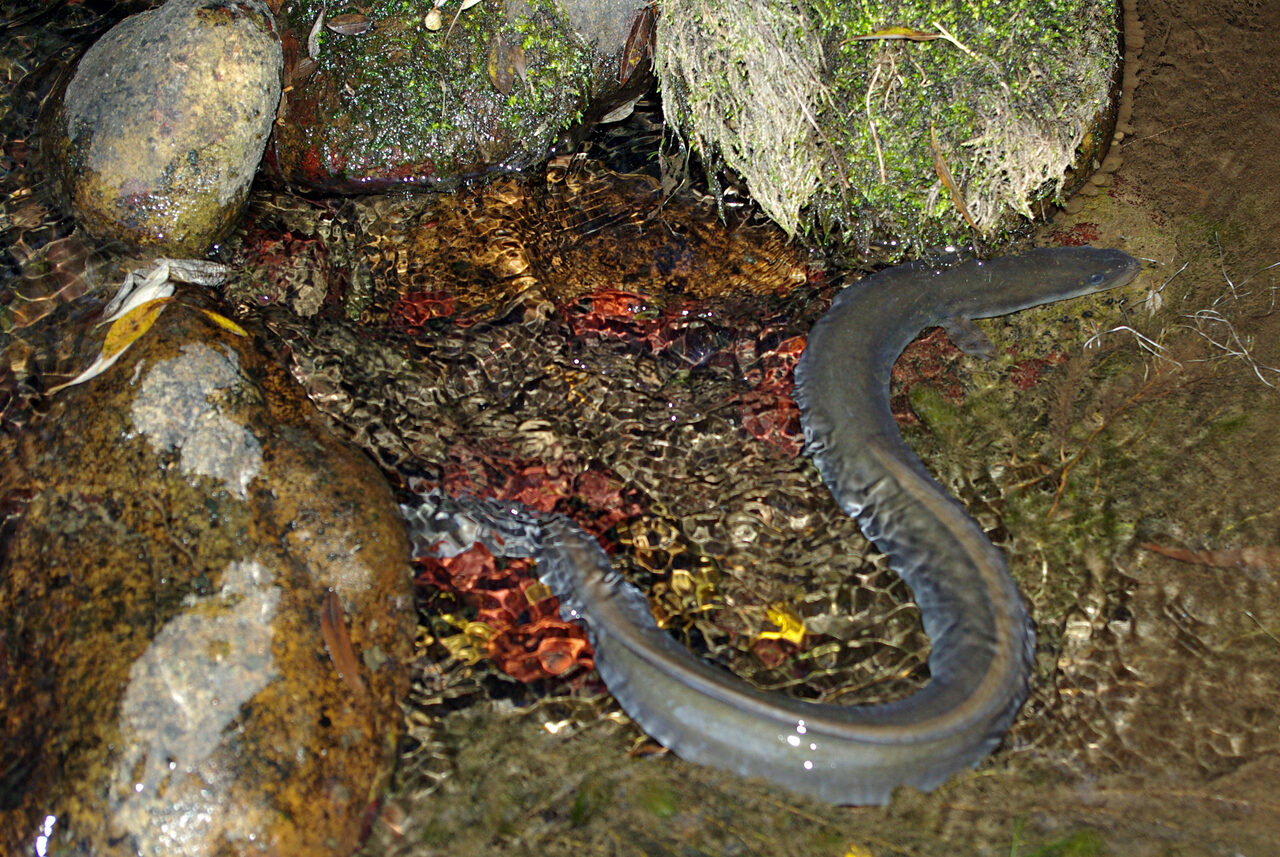
The living fish
More than an old plate
The historical engraving further up shows the eel as the old naturalists drew it. Here it is in the flesh - that rounded, muscular body and the fin seam running the whole way round the tail.
Catch report 2025
78
eels reported
30 cm
smallest fish
85 cm
biggest fish
64 cm
average size
Under threat
A fish in steep decline
The European eel is critically endangered: numbers have collapsed since the 1970s, and it stands on the Red List and under the Washington Convention. Barriers and turbines, lost habitat and the demand for glass eels all weigh on it. Take few or none - the stocking above is what keeps the eel in the river at all.
Biological and legal notes are a research draft; binding are the current ordinance and your permit. Rules & closed seasons.
In the kitchen
Rich, low-bone flesh, classically smoked. One caution: raw eel blood is toxic - thorough cooking or smoking destroys it completely.
Best time: warm, dark, thundery nights from spring to autumn, on a bottom rig with lobworm - strike promptly and steer the eel away from cover.
Good to know
Common questions about the eel
Why can't the eel be bred in the Saale?
Because it spawns only once, some 6,000 kilometres away in the Sargasso Sea in the Atlantic. No one has ever bred it in captivity, so the stock is supported with young stocked eels.
How does the eel even get into the Franconian Saale?
It used to travel here from the sea as a tiny, transparent glass eel. Because barrages now block the way, the region helps with stocking - most recently 100,000 young eels in a single day.
What is the eel taxi?
A lorry that gathers migration-ready eels before the Main turbines and drives them around the barrages to the Rhine. Each year that gets thousands past the first, most dangerous part of their journey to the sea.
Is eel blood really toxic?
Raw, yes - it contains a substance that should not get into eyes, mouth or open wounds. Cooking or smoking destroys it completely, so properly prepared eel is perfectly safe.
How do I tell an eel from a lamprey?
The eel has a true jawed mouth, one gill slit per side and small pectoral fins. The similar lamprey has a round sucking mouth, seven gill openings and no pectoral fins - and is protected year-round, so release it carefully.
How big and how old does an eel get?
Usually 60 to 80 centimetres; the odd female tops a metre. If an eel can no longer find its way back to the sea, it can grow very old - in rare cases over 50 years.
Fancy a cast?
Fish this stretch of the Saale
For the water at Wolfsmünster and Gräfendorf there are guest cards from a day ticket to a season permit, entirely without club membership.