Plate III · leading fish of the trout zone
Brown trout
Salmo trutta fario
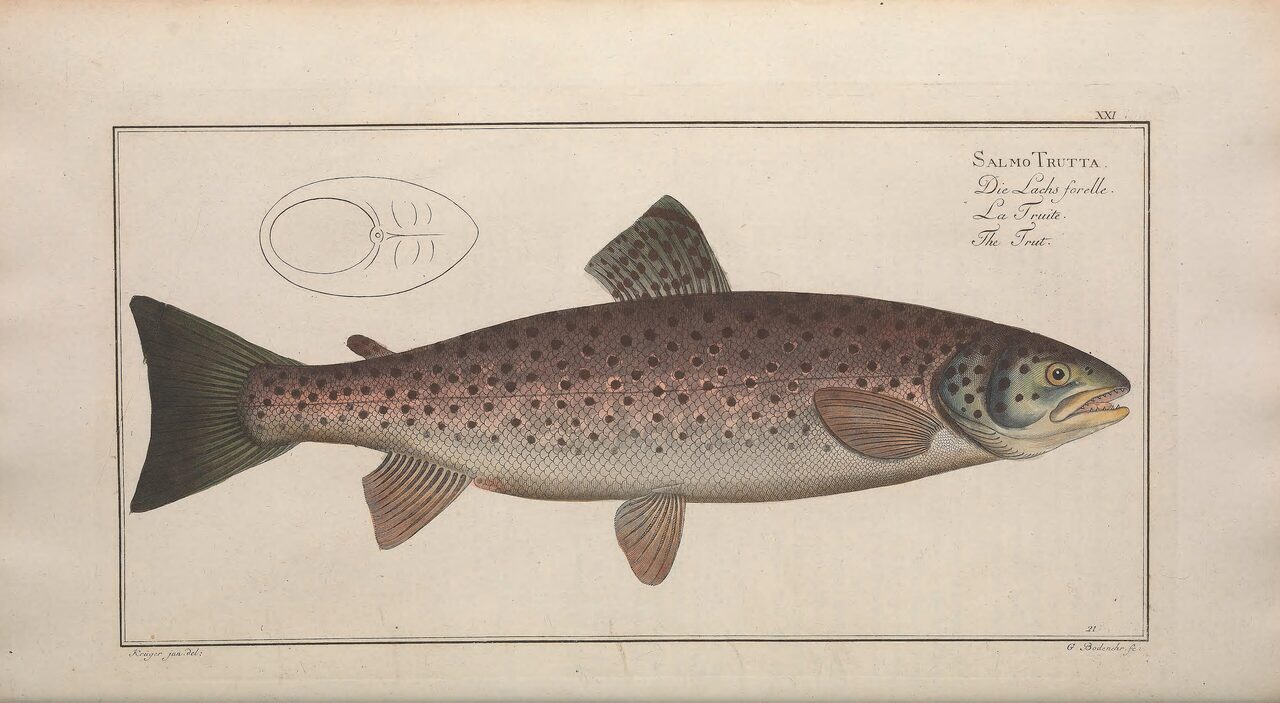
How to know it at once
- Red spots with a pale halo - even below the lateral line. The single most reliable sign.
- Black spots on an olive to brownish-green back, often pale-rimmed.
- Adipose fin before the tail - it is a salmonid.
- Deep mouth - the gape reaches back behind the eye.
The brown trout is the leading fish of the trout zone, the highest and coolest reach of a river. It loves clear, cold, oxygen-rich water over gravel and holds its ground behind stones and roots, head into the current. On the Franconian Saale it is mostly at home in the cooler headwaters and tributaries such as the Schondra and the Sinn.
As a native fish she defends her spot: hidden in the bank's shade by day, on the hunt for insects and windfall food at dusk.
- red spots with a halo
- almost unspotted tail fin
- olive-brown ground
- no red spots
- shimmering pink band
- densely spotted tail fin
Rule of thumb: red spots on the body mean brown trout.
The nursery of the pearl mussel
In the Schondra lives one of the last freshwater pearl mussels of Lower Franconia, and it depends on the brown trout like no other fish. No other fish of the region will serve as its host - without the trout, there is no young mussel.
- 1 · Late summer Millions of larvae The mussel releases millions of tiny larvae, the glochidia, into the water. Only a vanishing fraction ever finds a host.
- 2 · Through winter A ride in the gills A young brown trout breathes them in; for eight to ten months they ripen, safe in its gills, carried through the cold season.
- 3 · Early summer Back to the gravel As mussels barely half a millimetre across they let go, settling onto the clean gravel bed where they may live for decades.
What makes the brown trout special (here)
Opposite Schonderfeld lies the Seewiese fish farm, by its own account one of the oldest trout farms in Germany. From here, trout once travelled in special barrels as far as England and Russia.
A stock survey of the Schondra counted 85 brown trout along just 700 metres - among them a well-fed fish of 60 centimetres.
The brown trout's colours follow its water; every brook paints its trout a little differently, so no two are quite the same.
A wild brown trout takes its time: about five years to reach full size - far longer than the fast-growing rainbow trout.
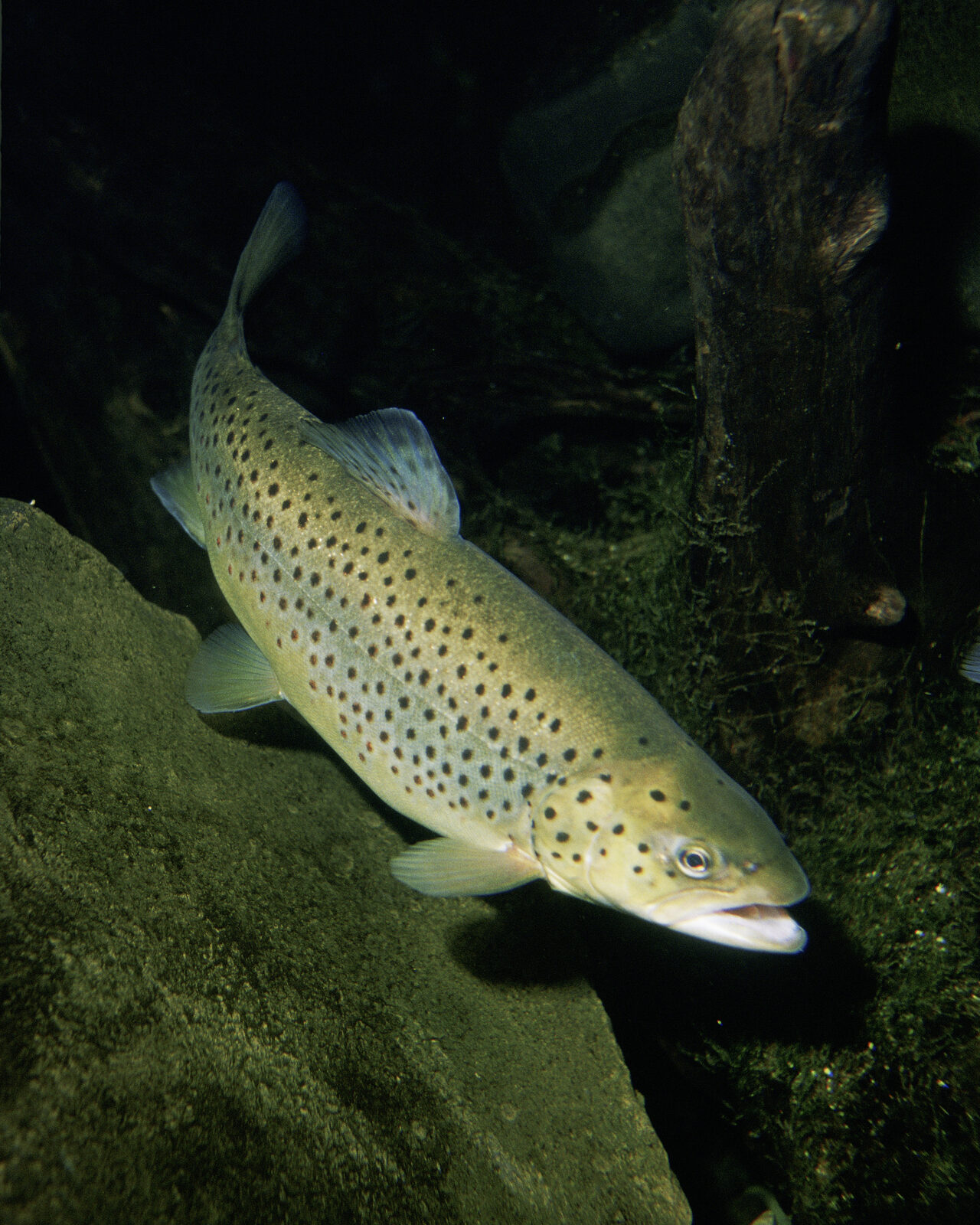
The spots for real
On the living fish they glow at their finest: the red spots with their pale halo, scattered across the flanks and down below the lateral line - every trout a one-off.
Choosy about clean water
The brown trout is on Bavaria's Red List. It needs cool, clean water and clean gravel to spawn, and both are becoming scarcer: sand settles over the spawning beds, weirs block the way to the spawning grounds upstream, and hot, dry summers take their toll. Predation by birds such as the cormorant is named too, though experienced conservationists stress it is one factor among several, not the sole cause.
Biological and legal notes are a research draft; binding are the current ordinance and your permit. Rules & closed seasons.
In the kitchen
Tender, fine flesh with few, easily removed bones - classically à la meunière, „blue“ or smoked. For the plate, the farmed trout is the one to choose; the wild, native brown trout may stay in its brook.
How to fish it: the fly or an ultralight spinner, stalked carefully upstream to the shy, station-holding fish. On trout brooks often only artificial baits are allowed - your permit says so.
Common questions about the brown trout
What does the brown trout have to do with the freshwater pearl mussel?
A great deal: it is the only fish in the region that can take up the mussel's tiny larvae. They ripen in its gills for eight to ten months, then drop onto the gravel as young mussels. Without the brown trout there would be no new pearl mussels in the Schondra.
How do I recognise a brown trout for sure?
By the bright red spots with a pale halo that sit even below the lateral line, together with black spots on an olive-brown ground and an adipose fin before the tail. Its mouth reaches back behind the eye.
Brown trout or rainbow trout?
Red spots on the body and an almost unspotted tail fin mean brown trout. No red spots, but a shimmering pink lateral band and a densely black-spotted tail fin, mean rainbow trout.
Why is the brown trout under threat?
It is choosy: cool, clean, oxygen-rich water and clean spawning gravel are essential. Siltation, weirs, hot dry summers and predation all weigh on it, and because it asks so much it is supported with locally bred young fish.
How big and old does it get?
In small brooks usually 25 to 35 centimetres, much more in richer waters; a 60-centimetre fish was recorded in the Schondra. It can live to around eighteen years.
How long have trout been farmed here?
Since 1882 at the Seewiese fish farm opposite Schonderfeld, one of the oldest trout farms in Germany. From there, trout travelled in special barrels as far as England and Russia well over a hundred years ago.
Fish this stretch of the Saale
For the water at Wolfsmünster and Gräfendorf there are guest cards from a day ticket to a season permit, entirely without club membership.