Plate IV · hardy immigrant from North America
Rainbow trout
Oncorhynchus mykiss
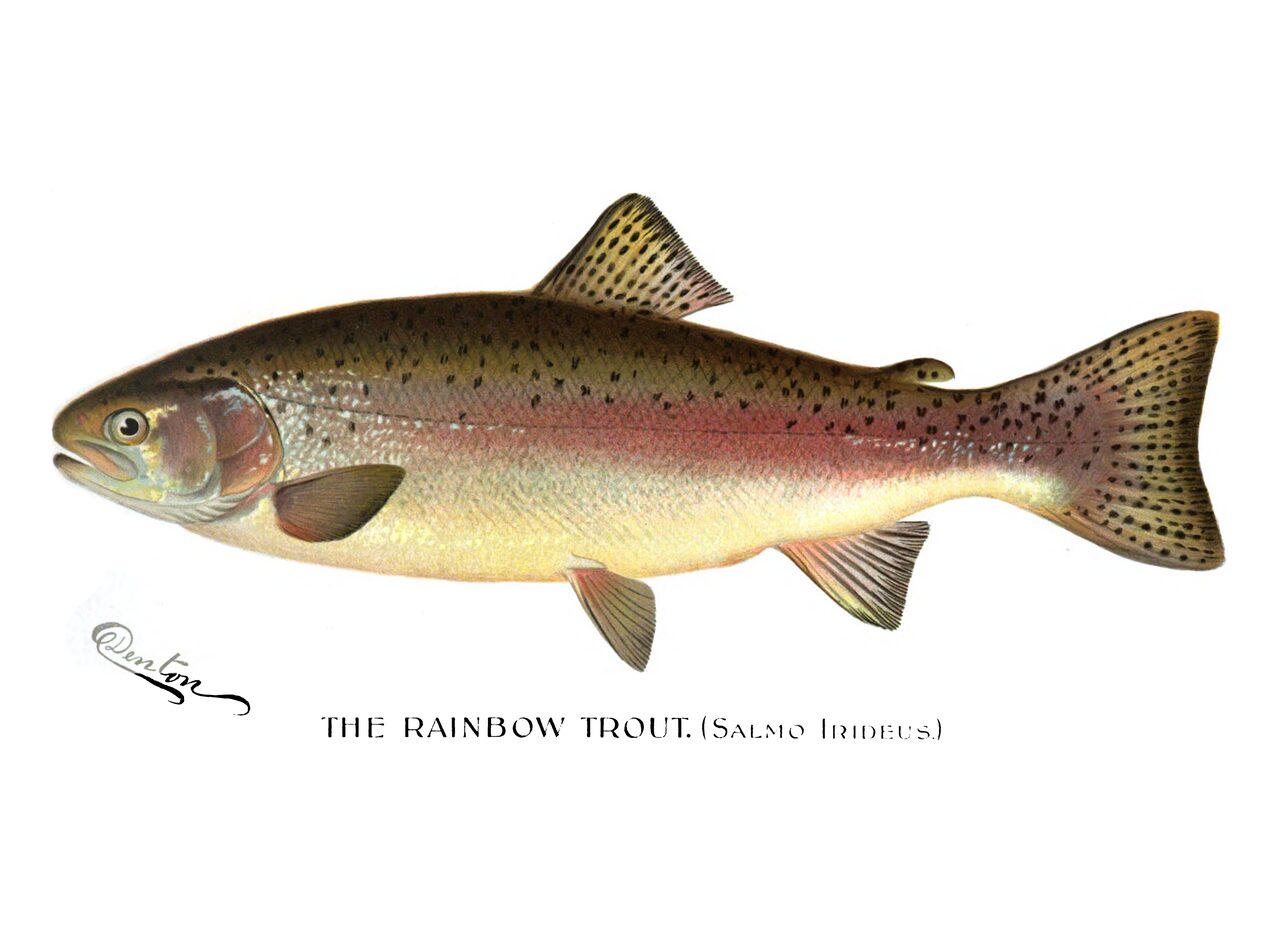
How to know it at once
- Black spots into the tail fin — the densely spotted tail is the surest single sign.
- Shimmering pink band along the flank, from the gill cover to the tail root.
- No red spots on the body, and no bright white fin edges.
- Adipose fin before the tail — she is a salmonid, too.
The rainbow trout is a lively, hard-fighting salmonid, and a newcomer: she was brought over from the Pacific coast of North America only around 1880. Hardier than the native brown trout, she copes with warmer, less oxygen-rich water and likes to hold out in the open current rather than in hiding.
On the Franconian Saale you meet her in the cooler, oxygen-rich reaches — in deep runs, back-eddies and the foaming water below weirs. She is here above all thanks to careful stocking; natural spawning succeeds only rarely.
- densely spotted tail fin
- shimmering pink band
- no red spots
- almost unspotted tail fin
- red spots with a pale halo
- olive-brown ground
Rule of thumb: spots into the tail plus a pink band mean rainbow trout.
The band that named her
No other trout of the Saale wears it: a broad, iridescent pink band that runs the whole length of the flank, brightest of all on the fish from running water. Add a tail fin peppered with fine black spots and the missing red dots, and the newcomer from North America is unmistakable.
What makes the rainbow trout special (here)
Her story on the Franconian Saale is a story of the fish farm: the Seewiese near Gräfendorf, by its own account the oldest trout farm in Germany, made the newcomer at home here long ago.
- around 1880 Across the Atlantic Brought over from the Pacific coast of North America — a robust newcomer that would settle into fish farms and rivers across Europe.
- 1882 A pond of her own At the newly founded Seewiese fish farm the rainbow trout was given her own pond right from the start, prized for how quickly she grows.
- 1903 & 1910 First prizes, eggs abroad The farm won first prize for its rainbow trout, and its eggs travelled as far as France and Russia — trout from the Saale, out into the world.
- 2.5–3 years The quick grower She reaches table size in about two and a half to three years — roughly half the time the native brown trout takes.
The band for real
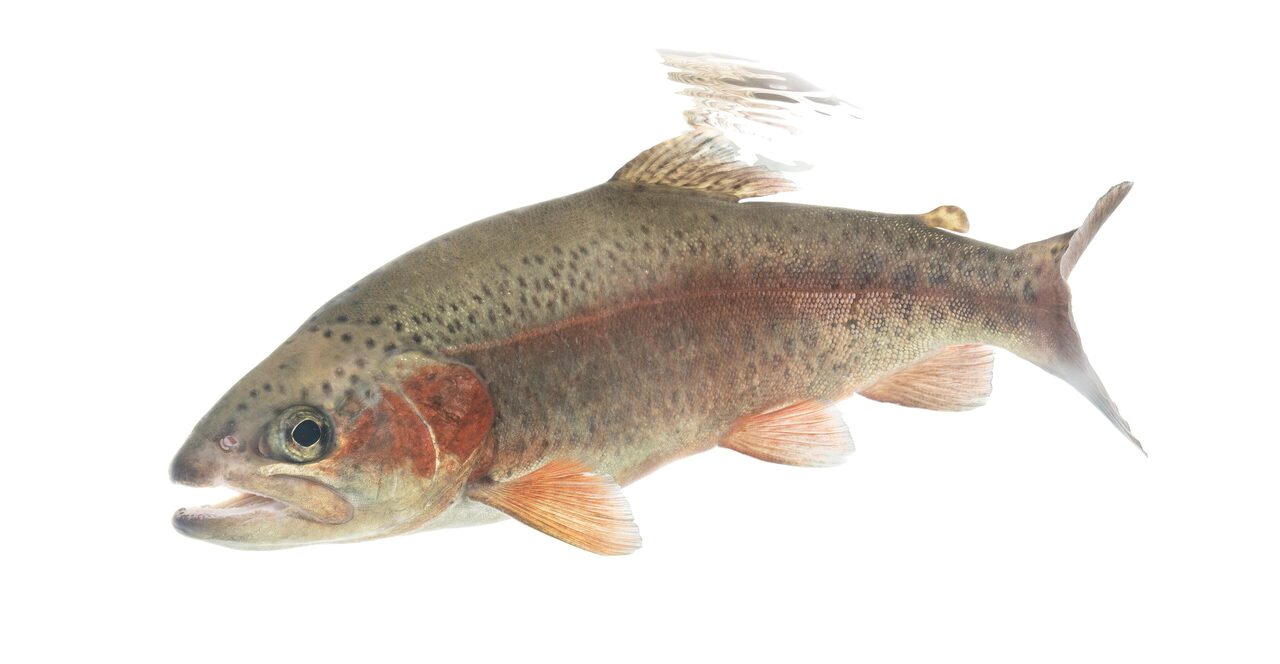
On the living fish you can see what the diagram only sketches: the pink shimmer along the flank, the fine spots running right into the tail, and not a single red dot. Every rainbow trout carries the band a little differently.
A guest, stocked with a sense of proportion
The rainbow trout is not endangered — quite the opposite: robust, adaptable and one of the most farmed fish in the world. As a non-native, though, she is stocked thoughtfully, because in cooler stretches she can compete for space with sensitive natives such as the grayling. Well judged, she is a wonderful sporting and table fish that takes the pressure off the wild brown trout; overdone, she can crowd others out. That balance is the whole art of it.
Biological and legal notes are a research draft; binding are the current ordinance and your permit. Rules & closed seasons.
In the kitchen
A first-rate table fish: tender, lean, finely flavoured and with few bones — pan-fried „à la meunière“, grilled, steamed or smoked. Sold with reddish flesh from a carotenoid-rich diet, she goes by the market name „salmon trout“, though she is a rainbow trout all the same.
How to fish it: versatile and sporting — a small spinner or trout plug, the fly, or natural bait on float and bottom. Look for her in the open current: deep runs, back-eddies and the foaming water below weirs.
Common questions about the rainbow trout
Rainbow trout or brown trout?
Look at the tail and the flank: a densely black-spotted tail fin and a shimmering pink band along the side mean rainbow trout. Red spots on the body and an almost unspotted tail mean brown trout. The rainbow trout wears no red spots at all.
Is the rainbow trout native to the Saale?
No. It comes from the Pacific side of North America and was first brought to Germany around 1880. In our region it lives above all thanks to stocking, because it very rarely spawns successfully in the wild here.
Why does it grow so much faster than the brown trout?
It simply puts on weight more quickly: a rainbow trout reaches table size in about two and a half to three years, while a brown trout needs around five. That fast, robust growth is exactly why fish farms took to it so early.
What is a „salmon trout“ (Lachsforelle)?
Just a market name, not a separate species. It is usually a rainbow trout whose flesh has turned reddish through a carotenoid-rich diet. On the plate it is a rainbow trout by another name.
Can it cope with warmer water than the brown trout?
Yes. The rainbow trout tolerates higher temperatures and lower oxygen better and, for short spells, water up to around 25 degrees. That is why it also thrives in warmer, faster stretches where the choosier brown trout struggles.
How do you fish for it?
Very versatilely: a small spinner or trout plug, the fly, or natural bait on a float or the bottom. Unlike the hidden brown trout it often holds out in the open current, in deep runs and the foaming water below weirs. Your permit sets the allowed methods.
Fish this stretch of the Saale
For the water at Wolfsmünster and Gräfendorf there are guest cards from a day ticket to a season permit, entirely without club membership.