Plate V · leading fish of the barbel zone
Barbel
Barbus barbus
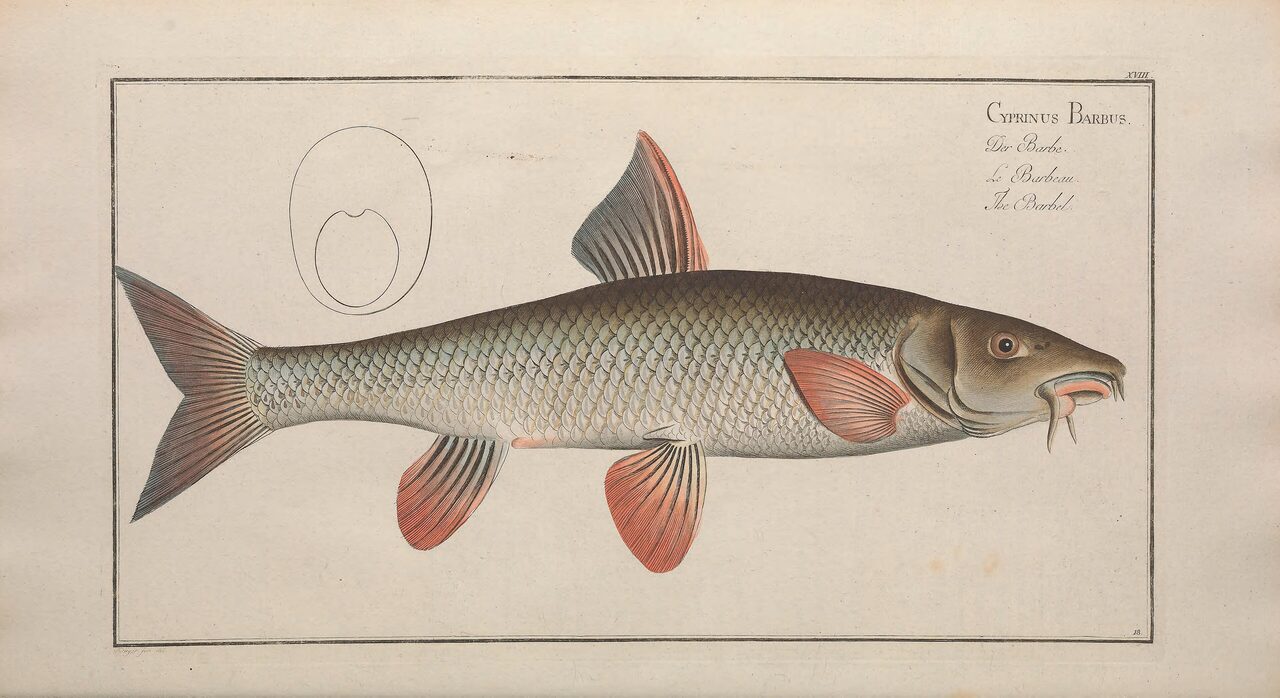
How to know it at once
- Four barbels - two at the snout tip, two at the corners of the mouth. The single most reliable sign.
- Underslung, snout-like mouth with thick, fleshy lips for grubbing the river bed.
- Long, almost round body - a muscular, torpedo shape built for strong current.
- Brassy flanks, reddish lower fins over an olive to grey-green back.
The barbel is the leading fish of the barbel zone, the lively, gravelly stretch below the cool grayling reach, and the Franconian Saale is a textbook example of it. A grouping bottom fish, it holds close to the bed in the fastest, best-oxygenated water: gravel bars, current seams, the scour behind stones, and below weirs and bridges.
By day it rests low; at dusk and into the night it works the bottom for insect larvae, snails, small crustaceans and worms. To spawn it runs upstream to clean, well-flushed gravel, which is why open, passable rivers matter so much to it.
- four barbels
- soft, fleshy lips
- long, round body
- no barbels at all
- hard, straight-edged lip
- slimmer, flat-sided body
Rule of thumb: count the barbels. Four means barbel, two means gudgeon, none means nase.
The living detector of the river bed
The barbel reads the river bottom by touch and taste. Around its low, snout-like mouth sit four fleshy feelers, the barbels, packed with sense cells. Nose-down over the gravel, it lets them trail across stones and sand and finds the hidden larva, snail or worm long before it ever sees it.
What makes the barbel special (here)
The barbel was named Fish of the Year 2003 - a fitting honour for the fish that gives the barbel zone its name, and for which the middle and lower Franconian Saale is a prime example.
In Bavaria the barbel has long gone by the friendly name Barm - a small everyday word for a fish that has always belonged to these rivers.
In the Saale's lively side stream, the Streu, barbel of up to seventy centimetres have been spotted - and hooked, a well-grown barbel is one of the hardest-fighting fish in the river.
Bypass channels on the Saale near Gräfendorf and on the Sinn near Schaippach, one of them 190 metres long, let gravel spawners like the barbel run upstream again - so the fish can migrate to breed instead of relying on stocking.
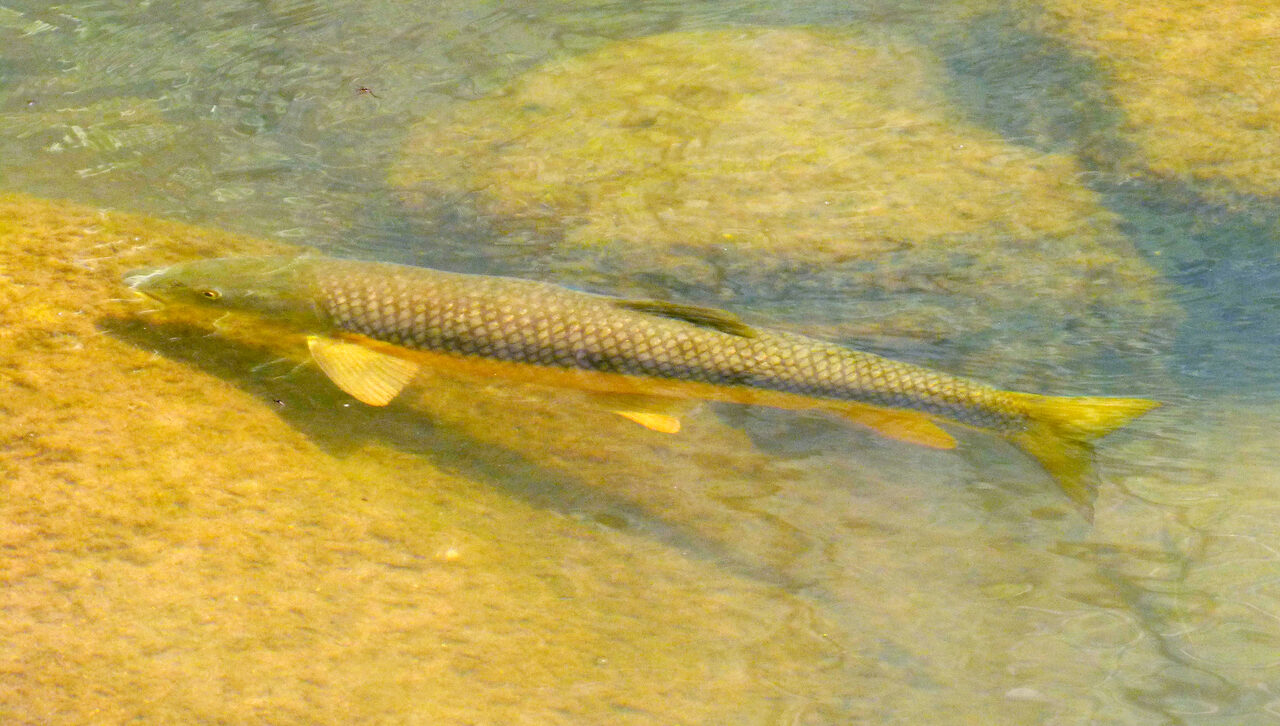
The barbels for real
The old engraving higher up only sketches them; on the living fish you can see them properly - the four fleshy feelers around a low, protruding mouth, and the long, muscular, brass-sheened body that lets the barbel hold in the fastest current with barely a beat of its fins.
A fish that needs clean gravel
The barbel is on the Red List. Like the trout and the nase it asks a lot of its water, so it suffers when rivers are dammed: weirs and power stations block the upstream spawning runs, and the still water above them silts up the clean gravel the barbel needs to breed. Warming summers add to the strain. Predation by birds such as the cormoran is named too, though it is fairly seen as one factor among several, not the sole cause - and the bypass channels are exactly the kind of help that lets the fish recover.
Biological and legal notes are a research draft; binding are the current ordinance and your permit. Rules & closed seasons.
Never eat the roe
One firm warning: the barbel's roe and milt are mildly toxic and strongly purgative - around spawning time they can cause nausea, vomiting and diarrhoea, the old barbel cholera. Remove and discard the roe and the belly flesh around it. The rest of the flesh is firm, if bony, and perfectly safe once thoroughly cooked.
How to fish it: ledgering or feeder tackle on a well-flowing gravel run, bait held on the bottom in the current, with sturdy gear - the barbel is a dogged, powerful fighter. Return undersized fish, and any caught in the closed season, gently.
Common questions about the barbel
How do I recognise a barbel for sure?
Count the barbels: the barbel wears four of them around a low, snout-like mouth with thick, fleshy lips. Two sit at the tip of the snout, two longer ones at the corners of the mouth. Add a long, almost round, muscular body and you cannot mistake it.
Barbel, nase or gudgeon?
It comes down to the barbels. The nase has none at all and a hard, straight-edged lip; the little gudgeon has just two. Only the barbel has four. Young barbel look much like a gudgeon, but even they already carry two pairs of barbels.
Is it true you must not eat the roe?
Yes. The roe of the spawning female, and the milt too, are mildly toxic and act as a strong purgative. Eaten around spawning time they can bring on nausea, vomiting and diarrhoea, an old complaint once nicknamed barbel cholera. Remove and discard the roe and the belly flesh around it. The rest of the flesh is safe once thoroughly cooked.
Why does the barbel have a closed season and a minimum size?
Because it spawns in early summer over clean gravel and migrates upstream to do so. The closed season and the minimum size protect the fish during spawning and let it breed at least once before it can be taken. Your permit and the local rules always come first.
How do you fish for barbel?
On or near the bottom of a well-flowing gravel run: ledgering or feeder tackle with a bait held down in the current, or a drifting float. Sturdy gear pays off, because the barbel is a famously hard, dogged fighter that bores straight for cover.
Why is it called barbel, and what is a Barm?
The name comes from the Latin barba, a beard, after the four barbels around its mouth. In Bavaria the fish has long been known by the homely name Barm.
Fish this stretch of the Saale
For the water at Wolfsmünster and Gräfendorf there are guest cards from a day ticket to a season permit, entirely without club membership.