Plate VI · the striped pack hunter
Perch
Perca fluviatilis
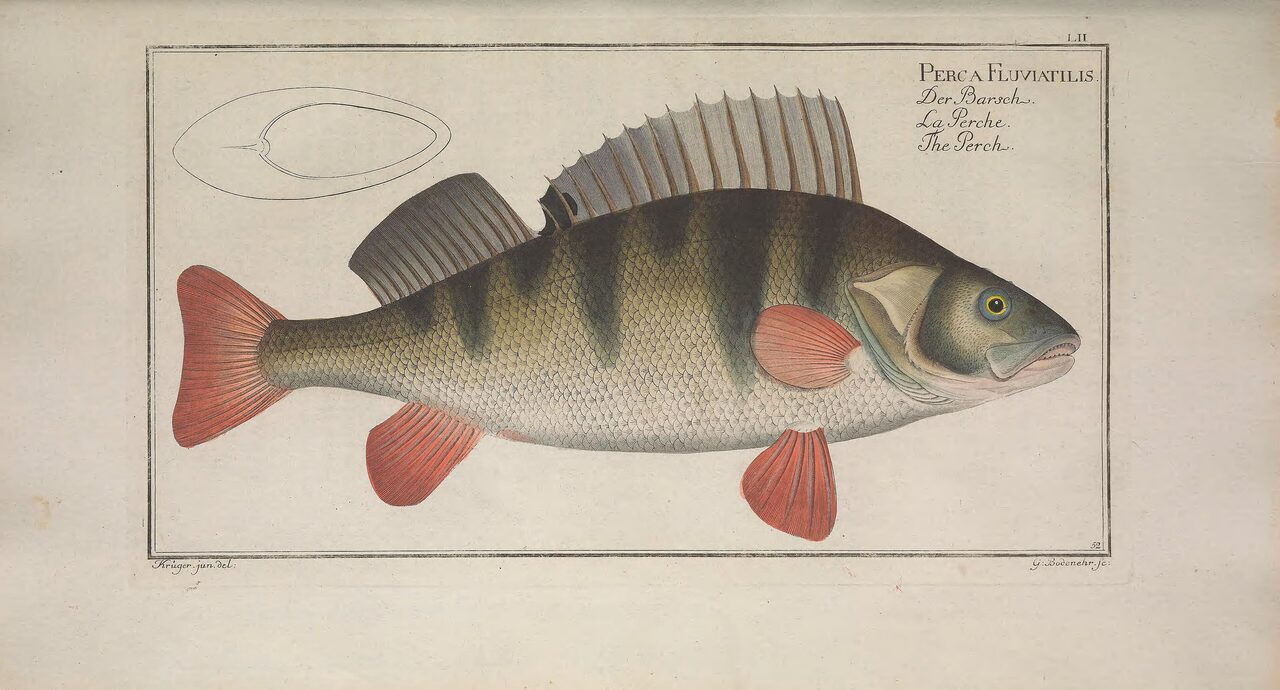
How to know it at once
- Six to eight dark bars — vertical stripes on a green-gold body, like a tiger. The first thing you see.
- Spiny first dorsal fin with a black spot at its rear edge — the divided dorsal marks a true perch.
- Orange-red fins on belly, anal and pectorals — a warm glow no zander shows.
- Rough armour — comb scales and a spine on the gill cover earn it the name spiny knight.
The perch is a curious, adaptable predator and thoroughly at home in the Franconian Saale. Young fish roam in shoals, while big old ones hunt alone or in small packs. They are not tied to one spot but wander in search of the best mix of cover and ambush, holding by stone packs, deadwood, groynes and weirs, and in the calmer, deeper reaches.
Near Gräfendorf you will find them lying in the current-shadow behind the bridge piers, waiting, close to the reeds where roach and bream and the bigger predators gather too.
- divided dorsal fin
- bold vertical bars
- red fins, scaled head
- one continuous dorsal fin
- blotches, no clear bars
- no red fins, bare head
Rule of thumb: a split dorsal fin and red fins mean perch.
A pack against the newcomer
No fish of the Saale is easier to name: the three R do it in a glance. But the perch is more than a pretty coat. When the round goby pushed up from the Black Sea by way of the Danube and Main, the perch was the first of our predators to take it on, hunting the newcomer in packs like wolves. That is why it is stocked here on purpose today, as a living, natural counterweight.
- 1 · The newcomer The goby arrives The round goby travels up from the Black Sea by way of the Danube and Main and settles into the stones of the Saale in no time.
- 2 · The answer The perch acquires a taste The perch is the first of our predators to make a real meal of the newcomer, hunting it in packs along the bottom.
- 3 · The plan Stocked on purpose Recognising this, the local fishery began stocking perch deliberately, as a living, natural counterweight to the goby.
- 4 · The knock-on The others follow After the perch led the way, pike and zander took to the goby too, and on rich goby fare the perch itself grows sturdier.
What makes the perch special (here)
Year in, year out the perch ranks among the most-caught fish of our stretch, close behind the eel and the roach — a dependable, everyday companion of the Saale angler.
With its bars flowing into a tiger pattern and up to fourteen or fifteen spines standing in the first dorsal fin, the perch is counted among the most striking fish in the river.
At Gräfendorf greedy perch hold in the current-shadow behind the bridge piers, waiting for anything edible to drift past — a favourite spot worth searching carefully.
Since the perch took to the plentiful round goby, local anglers report noticeably sturdier, better-fed fish — the newcomer, it turns out, makes very good perch food.
A hardy all-rounder
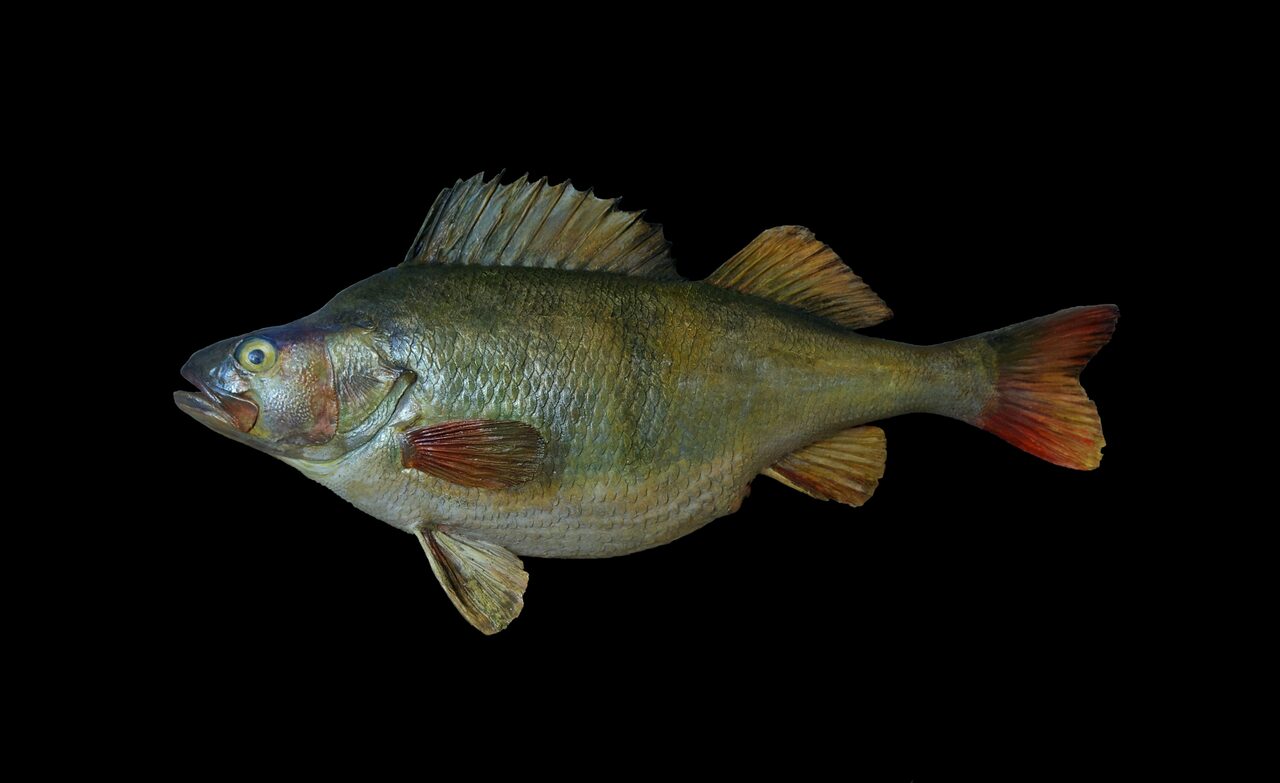
The perch is one of the least fussy of our fish. It thrives in flowing and still water alike and asks little of its home, so it is not among the threatened species and needs no special protection here. Predation by birds is one factor among several in the life of any river fish, no more; a healthy, structure-rich water carries a good perch stock on its own. Handled fairly around the spawning time in spring, the stock looks after itself.
Biological and legal notes are a research draft; binding are the current ordinance and your permit. Rules & closed seasons.
In the kitchen
White, firm, lean flesh with few bones — a highly prized table fish. Best filleted, then breaded and fried golden in the pan; in Switzerland the perch is a favourite under the name Egli, served as crisp little fillets.
How to fish it: find the pack and stay on it — small soft plastics on a drop-shot rig, little spinners, spoons or crankbaits, or a single lively lobworm. Search the structure: stone packs, deadwood, groynes, bridge piers and weir pools.
Common questions about the perch
How do I recognise a perch for sure?
By the rule of three R: Red fins, Rows of bars and a Roof-like spiny dorsal. Six to eight dark vertical bars on a green-gold body, orange-red pelvic, anal and pectoral fins, and a divided dorsal fin whose front part is stiff and spiny and carries a black spot at its rear edge. No other fish of the Saale combines all three.
Perch or zander?
The perch is stocky and high-backed with bold vertical bars, red fins and a black spot on the first dorsal. The zander is slim and long, has no such spot, wears fang-like teeth and lacks the red fins. If the black spot and the bars are there, it is a perch.
Why does the perch help against the round goby?
The round goby travelled up from the Black Sea by way of the Danube and Main and settled in fast. The perch was the first of our predators to take a real liking to it, hunting the newcomer in packs. Because of that it is now stocked here on purpose, as a natural counterweight; later the other predators followed its lead.
Does the perch have a closed season or a minimum size?
In Bavaria there is no statutory closed season and no statutory minimum size for the perch. Local conservation rules can be stricter, though: some stretches around the Saale set their own spring closed season and a minimum size of 25 centimetres. Your permit for the water is what counts, so check it.
How big and how old does a perch get?
Most are 20 to 35 centimetres; anglers call one from 40 centimetres a specimen, and a fish over 50 is the catch of a lifetime. Given rich feeding it grows sturdier, and a perch can reach a surprising age of up to around twenty years.
How do you fish for perch?
Find the pack and you often catch several in a row. Small soft plastics on a drop-shot rig, little spinners, spoons or crankbaits work well, and a single lively lobworm is a classic. Search the structure: stone packs, deadwood, groynes, bridge piers and weir pools.
Fish this stretch of the Saale
For the water at Wolfsmünster and Gräfendorf there are guest cards from a day ticket to a season permit, entirely without club membership.