Plate VII · leading fish of the bream zone
Bream
Abramis brama
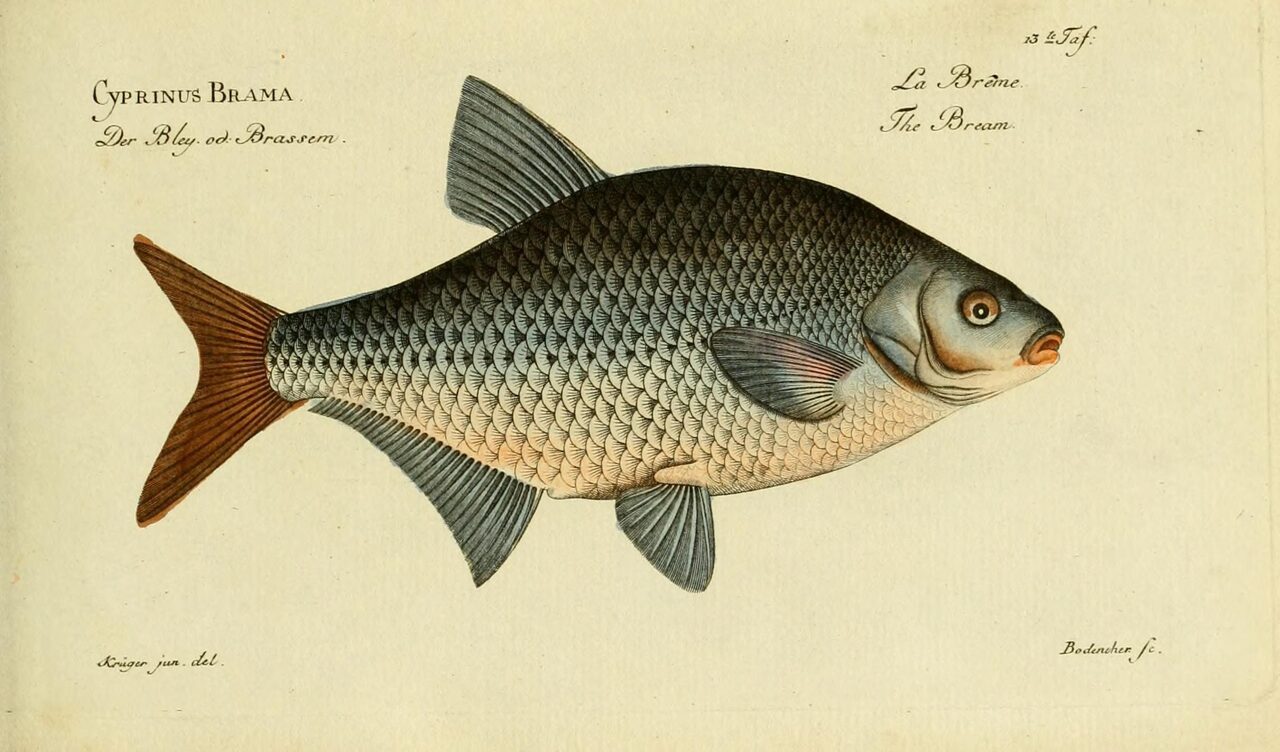
How to know it at once
- Deep, flat body - tall and broad from the side, knife-thin from the front. The quickest sign of all.
- Very long anal fin with 26 to 31 rays, running far along the belly.
- Grey to dark fins - never reddish. The fastest way to rule out the silver bream.
- A thick coat of slime over big scales; older fish glow bronze to gold.
The bream, here often called Brachse, is the calm, sociable bottom fish of the slow, deep water and the fish that gives the bream zone its name. On the Franconian Saale it keeps to the quieter reaches: the deeper, gently flowing stretches of the lower river, the still water above weirs, and the weedy bays and old side arms. By day it holds deep in big shoals, at dusk and by night it moves into the shallows to feed.
Where the current eases and the bottom turns soft and muddy, the bream is at home: a herd animal that travels, feeds and rests as a shoal.
- grey to dark fins
- small eyes
- very long anal fin
- reddish fin bases
- large eyes
- shorter anal fin
Rule of thumb: reddish fins plus large eyes mean silver bream.
The vacuum cleaners of the soft bottom
The bream carries a small marvel in its head: a mouth it can push forward into a downward-pointing tube. Tilting head-down, a whole shoal ploughs the soft bottom, sieving out midge larvae, worms, snails and tiny mussels. What it leaves behind gives it away: little craters in the mud and a fine veil of rising bubbles.
What makes the bream special (here)
When a stretch of the Franconian Saale was surveyed fish by fish, the bream that turned up averaged a handsome 46 centimetres - proof that the quiet reaches here grow it well.
At the local fishing days the deep bronze bream is again and again the biggest fish of the day, with well-fed specimens tipping the scales close to two kilograms.
Old regional names tell of its colour: Brachse here, and Blei elsewhere, after the lead-grey shimmer of the young fish that only later warms into bronze and gold.
A careful stock survey of the Saale above the campsite counted seventeen species and found the bream among them - and the result turned out better than anyone had hoped.
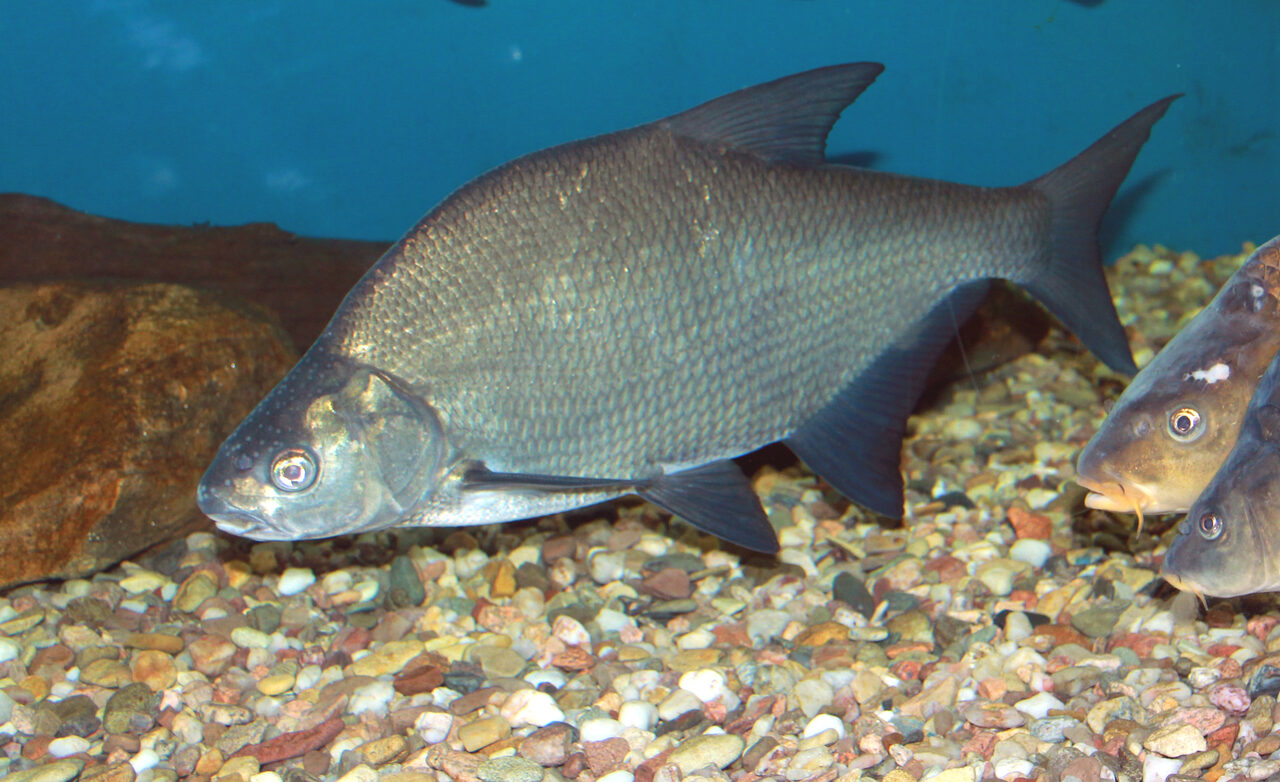
The bronze for real
The old plate above shows the shape; here you can see the colour. Notice the tall, laterally flattened body, the uniformly dark fins with never a hint of red, and the warm bronze glow that an older bream takes on over the years.
Fewer bream than there once were
The bream is not legally protected in Bavaria, and it long counted among the most everyday fish of the region. Yet locally it has grown scarcer. Shifting nutrient levels and clearer water that favours sight-hunters, the loss of soft, weedy bottom habitat, and predation all play a part. Predation by birds such as the cormorant, and by the otter, is named too, though experienced conservationists stress it is one factor among several, not the sole cause. Some clubs now choose to spare the large spawning females so that the shoals can recover.
Biological and legal notes are a research draft; binding are the current ordinance and your permit. Rules & closed seasons.
In the kitchen
Tasty but bony: the bream is threaded with fine Y-shaped bones. That is why it shines minced into fish cakes or smoked, which counts as a real delicacy; larger fish are far easier to bone. In parts of eastern and southern Europe it is prized more highly than it tends to be here.
How to fish it: patient groundbaiting on a single spot, classically with the feeder or a bottom rig, early morning and at dusk. Maggots, worms or corn where permitted, and watch the surface: a trail of rising bubbles betrays a feeding shoal. No legal minimum size, but your permit and the local rules come first.
Common questions about the bream
Bream or silver bream?
Look at the fins and the eyes: the bream has uniformly grey to dark fins and small eyes, plus a very long anal fin. The silver bream (Güster) shows a reddish tinge at the base of its pectoral and pelvic fins, larger eyes and a shorter anal fin. Reddish fins mean silver bream, grey ones mean bream.
Why is the bream so slimy?
That thick coat of slime is perfectly healthy. It protects the skin against injury, parasites and infection and lets the fish slip through weed and past obstacles. Handle it with wet hands so you take as little of it as possible.
Where do all those little bubbles come from?
From a feeding shoal at work. As bream root through the soft bottom with their extendable mouths they stir up gas trapped in the mud, and it rises as a veil of fine bubbles. Anglers read those bubble trails to find the fish.
Does the bream have a closed season or a minimum size?
In Bavaria there is no statutory closed season and no legal minimum size for the bream. That does not mean anything goes: your permit and the local fishery rules may set their own minimum size, bag limit or spawning protection, and those are binding. General animal-welfare rules always apply.
How big and how old does a bream get?
Usually 30 to 50 centimetres and around a kilogram; well-grown fish reach close to 85 to 90 centimetres and eight to nine kilograms. A bream can live to about eighteen or twenty years.
Can you eat bream?
Yes, though it carries many fine Y-shaped bones. It is at its best minced into fish cakes or smoked, which is regarded as a delicacy; larger fish are far easier to bone than small ones. In parts of eastern and southern Europe it is prized more highly than here.
Fish this stretch of the Saale
For the water at Wolfsmünster and Gräfendorf there are guest cards from a day ticket to a season permit, entirely without club membership.