Plate VIII · ambush predator of the quiet groynes
Pike
Esox lucius
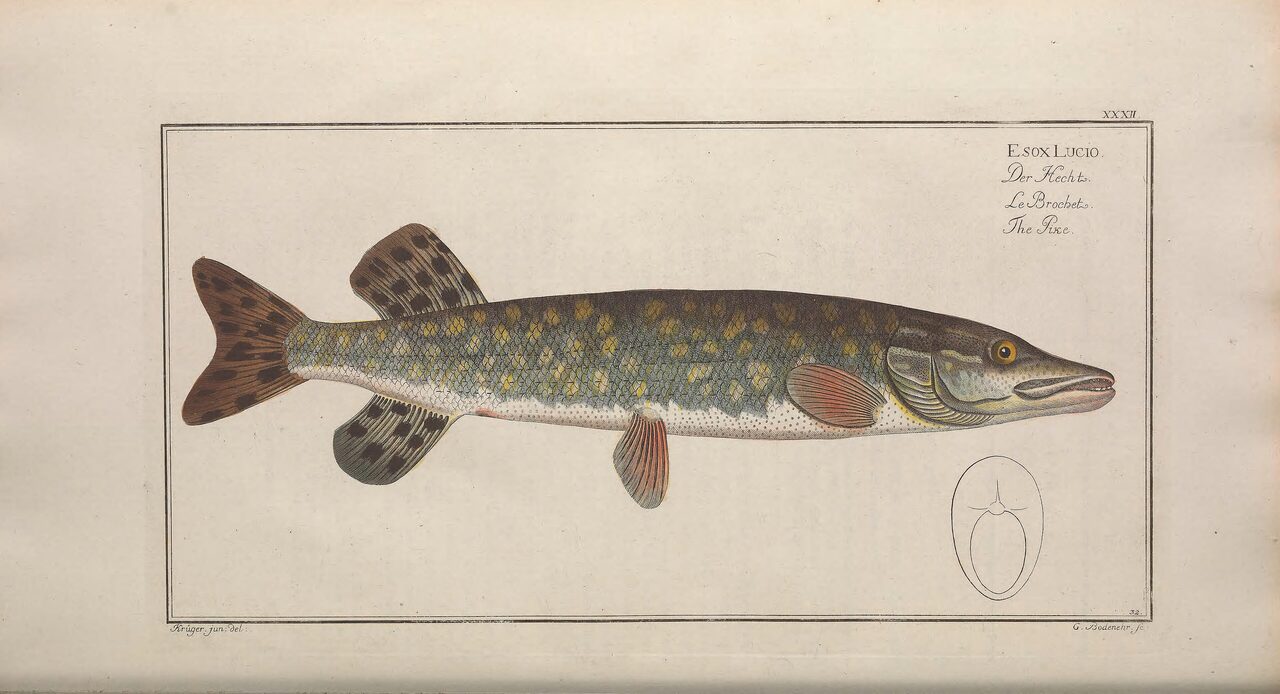
How to know it at once
- The duck-bill snout - a long, flat, wide-gaping mouth with strong fangs. The single most reliable sign.
- Fins set right at the back - dorsal and anal fin sit almost opposite each other just before the tail: the pike's rear drive.
- Torpedo body - long, cylindrical, almost round in cross-section, built to launch.
- Camouflage colours - green to brownish with pale flecks and bars, a hide for the weed.
The pike is the apex ambush predator of the river. It does not chase in open current; it lies motionless in cover, camouflaged among weed, reeds and deadwood, and strikes from a standstill in a heartbeat. On the Franconian Saale it holds exactly where the flow calms: the quiet water of the groyne fields, old backwaters, weed and reed zones, deep pools and the slack behind weirs.
That is also why old country lore calls him the water wolf: patient, perfectly still, then all at once explosive.
- duck-bill snout
- soft fins, set at the tail
- green with pale flecks
- perch-like, terminal mouth
- two dorsal fins, hard spines
- grey with dark bars
Rule of thumb: duck-bill plus fins at the very back means pike.
The strike from the shadows
Everything about the pike is built for one moment: the sudden ambush. The whole body is a launch tube, and the dorsal and anal fins, tucked right back by the tail, act as a rear drive that fires it forward from a dead stop. What looks like a green stick in the weed becomes, in a fraction of a second, a set of jaws.
- 1 · Lie in wait Motionless in cover The pike hangs stock-still at the edge of the weed, reading the water through its lateral line and waiting for prey to drift within reach.
- 2 · The launch Explosive from a standstill In a fraction of a second the rear fins fire the whole body forward: a short, brutal sprint that gives the prey almost no warning.
- 3 · The seize Hundreds of teeth Sideways the jaws snap shut; backward-hinged teeth on the roof of the mouth hold fast, and the prey is turned and swallowed head first.
The pike as the river's keeper of order: the work of hege fishing
What makes the pike special (here)
The largest pike ever documented here measured a staggering 1.23 metres, taken above the Gräfendorf power station. Tellingly, it had the remains of a fellow pike of some 50 to 60 centimetres in its stomach.
In a strong year the Gemünden fishers have released as many as ten thousand young pike into the Main and Saale, most of them a hand-length long, spring and autumn alike.
When the water rises in spring, the shallow, flooded groyne fields below Schonderfeld turn into pike spawning grounds: the sticky eggs cling to flooded plants, and that is exactly what the closed season protects.
The pike earns its keep: together with zander and perch it is one of the few natural answers to the invasive round goby that spread through the river, keeping the newcomer's numbers in check.
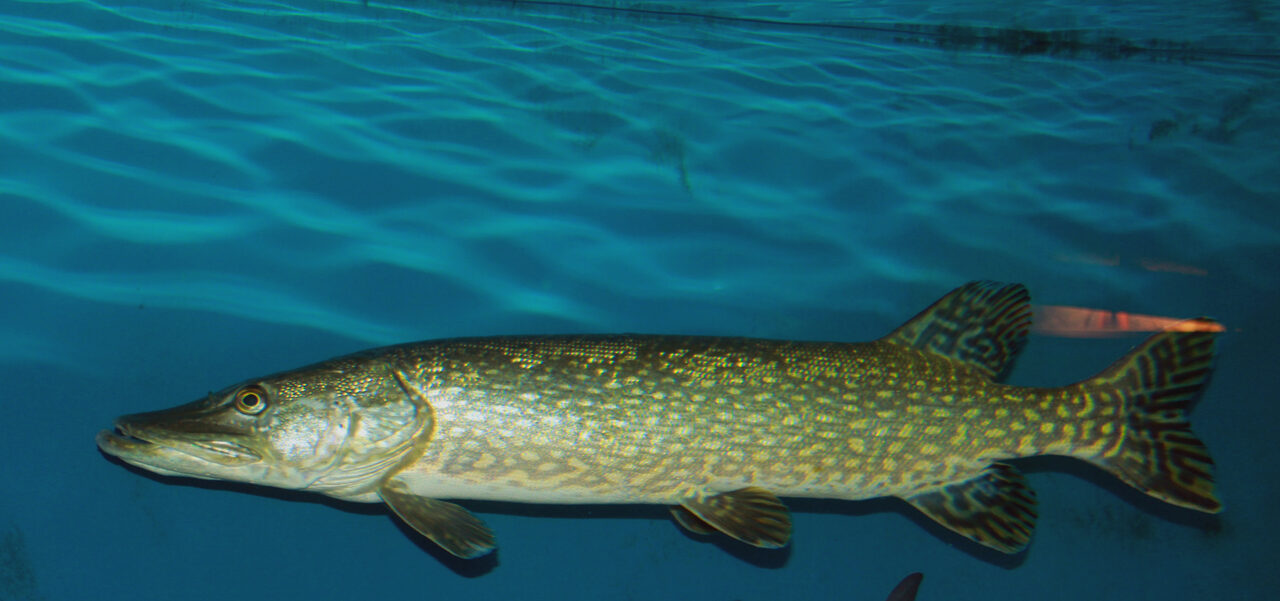
The water wolf for real
The old plate only hints at it; on the living fish you can read it at a glance: the flat duck-bill snout, the green camouflage that dissolves into the weed, and the fins carried right back by the tail, ready to fire.
It stands or falls with the floodplain
The pike is not as rare as the eel or the grayling, but it hangs on one thing: intact banks and floodplains. It spawns on shallow, flooded meadows in spring, and where those floods fail to come the young have nowhere to hatch. River regulation, weirs and turbines all weigh on it. Predation by birds such as the cormorant, and by big catfish, is named too, but it is one factor among several, not the sole cause. Its dependence on healthy margins is exactly why it was chosen Fish of the Year 2016.
Biological and legal notes are a research draft; binding are the current ordinance and your permit. Rules & closed seasons.
In the kitchen
Firm, white, lean flesh with a fine flavour, prized on the table. Its one drawback is the many fine Y-bones: the classic answer is to fillet and finely score the flesh, or turn it into quenelles and pike dumplings. A regional favourite is pike in a creamy sauce.
How to fish it: spinning is the classic - wobblers, soft baits, spoons and spinners worked along weed edges, groyne fields and weir pools. A wire trace is a must against the teeth, and dead bait fish beats live for hooking.
Common questions about the pike
How do I recognise a pike for sure?
By two things at a glance: the long, flat, duck-bill snout with its wide gape, and the dorsal and anal fins set right at the back of the body, almost opposite each other just before the tail. That combination fits no other native fish, even in young ones. Rule of thumb: duck-bill plus fins at the very back means pike.
Pike or zander?
The pike wears the duck-bill snout and carries its soft, single-part fins right at the tail; its body is green with pale flecks. The zander has a perch-like build, two separate dorsal fins with hard spines, and a couple of long fangs in a terminal mouth. One look at the head and the rear fins settles it.
Why is the closed season 15 February to 30 April, and the minimum size 50 centimetres?
Because the pike spawns in early spring, as soon as the water reaches around nine degrees. It is a plant-spawner: it needs shallow, flooded, plant-rich margins to stick its eggs to. The closed season protects it exactly then. The 50-centimetre minimum lets a pike spawn at least once before it may be taken; your permit or local rules can be stricter, never milder.
Why does pike fishing need a wire trace?
Because the pike is armed like few other fish: strong fangs in the lower jaw and hundreds of small, backward-hinged teeth across the roof of the mouth that give the prey almost no way out. A plain line is bitten through in an instant, so a wire or hard-mono trace is a must.
Is it true that pike eat their own kind?
Yes. The pike knows no restraint about the size of its prey, and even small pike from a few centimetres up will take one another. The largest pike ever landed near Gräfendorf, an incredible 1.23 metres, had the remains of a fellow pike of some 50 to 60 centimetres in its stomach.
How big does a pike get in the Franconian Saale?
Most fish are between 50 and 100 centimetres; a stock survey here found an average length of about 68 centimetres. Females grow noticeably larger than males. Now and then a true giant turns up: the local record stands at 1.23 metres and around 13 kilograms, taken above the Gräfendorf power station.
Fish this stretch of the Saale
For the water at Wolfsmünster and Gräfendorf there are guest cards from a day ticket to a season permit, entirely without club membership.