Plate IX · warmth-loving bottom-grubber of the quiet bays
Carp
Cyprinus carpio
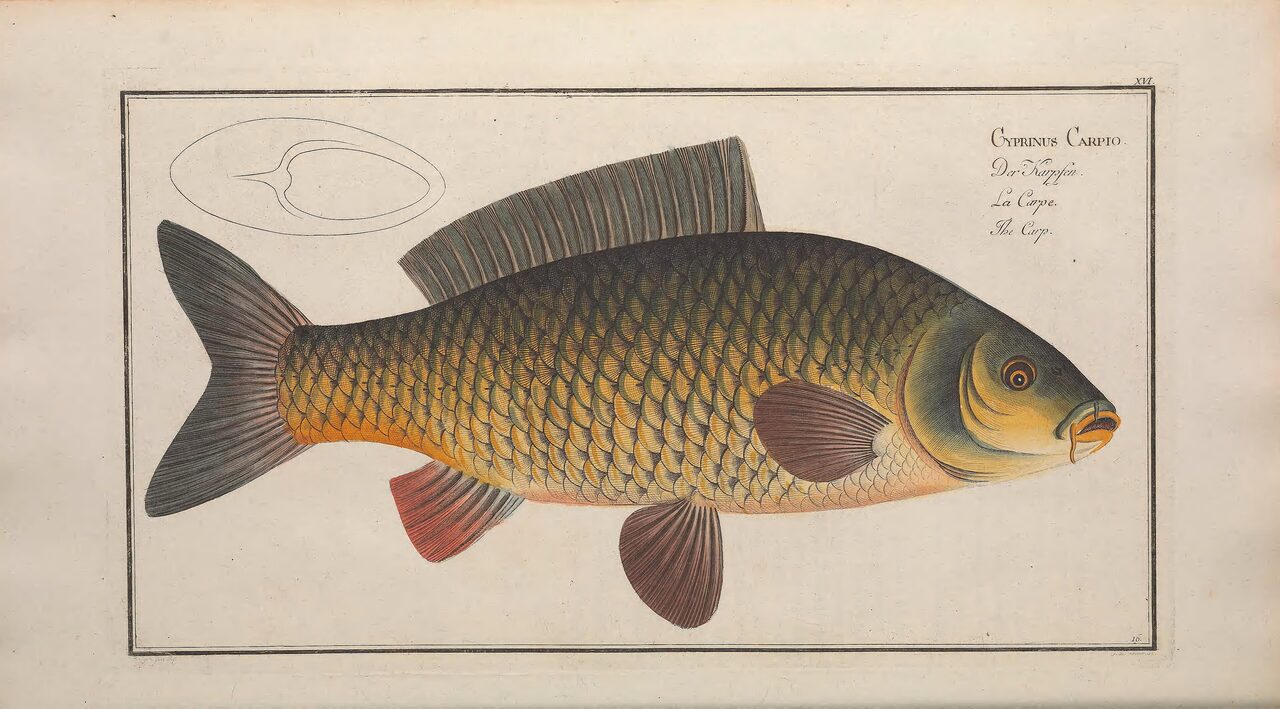
How to know it at once
- Four barbels, two pairs - a shorter front pair and a longer rear pair at the mouth. The single safest sign; no lookalike here has them.
- Downward, protrusible mouth with fleshy lips, made for grubbing along the bottom.
- Long dorsal fin running far down the back, its outer edge curved inward.
- A changeable coat of scales olive-green with brassy-golden flanks - fully scaled, mirror or leather.
The carp is a warmth-loving, peaceful bottom fish of the slow, warm lower reaches - the bream zone - and of still waters. In a mid-mountain river like the Franconian Saale you will not find it in the cool, quick headwaters, but in the calm, warmer stretches: the impounded reaches, wide quiet flats, bays and backwaters, and the slack water behind groynes and weirs, ideally among plants and overhanging branches.
He grubs the bottom for food, likes company in small groups, and is famously wary and clever. A carp can grow old, and an old carp has learned a great deal - which is exactly what makes him such a rewarding fish to outwit.
- four barbels
- long dorsal fin
- olive-golden body
- no barbels at all
- deep, stocky body
- protected year-round
Rule of thumb: barbels mean carp. A barbel-less lookalike may be a protected crucian carp - release it carefully.
The carp's three coats of scales
Scaled carp, mirror carp, leather carp - they are all the very same fish, Cyprinus carpio. Only the coat of scales tells them apart, and that coat is the work of centuries of patient pond breeding, much of it in the ponds of monasteries. Legend even credits clever monks with the mirror carp's few large, shiny scales, so much easier to clean for the fasting table.
- the full coat Scaled carp Evenly covered in regular scales from head to tail - the coat closest to the original wild carp.
- the mirror coat Mirror carp Only a scatter of large, shiny mirror scales along back and flanks, otherwise bare - the form most tied to the old pond breeders.
- the bare coat Leather carp Almost scaleless, with smooth, leathery skin - the rarest of the three coats.
What makes the carp special (here)
Brought north from the east in antiquity, the carp became the great fish of the Middle Ages: monks bred it in their ponds as a nourishing food for the long fasting seasons. That heritage still flavours the region's fondness for it.
At the Seewiese fish farm near Schonderfeld, carp share the lowest of the terraced ponds - raised in part to be released into the Saale, and to work the bottom of trout waters where they keep the algae down.
Carp around 60 centimetres are on record from the Franconian Saale, and a young angler once landed a mirror carp of some eight kilos here after a three-quarter-hour fight - proof that real carp swim these waters, not just pond stock.
The carp needs warmth, so in the cool, clear spring water of the region it grows slowly - around five years to a good table size. In return, a fish raised in clear water never tastes muddy, and a carp left to grow on can reach a fine old age.
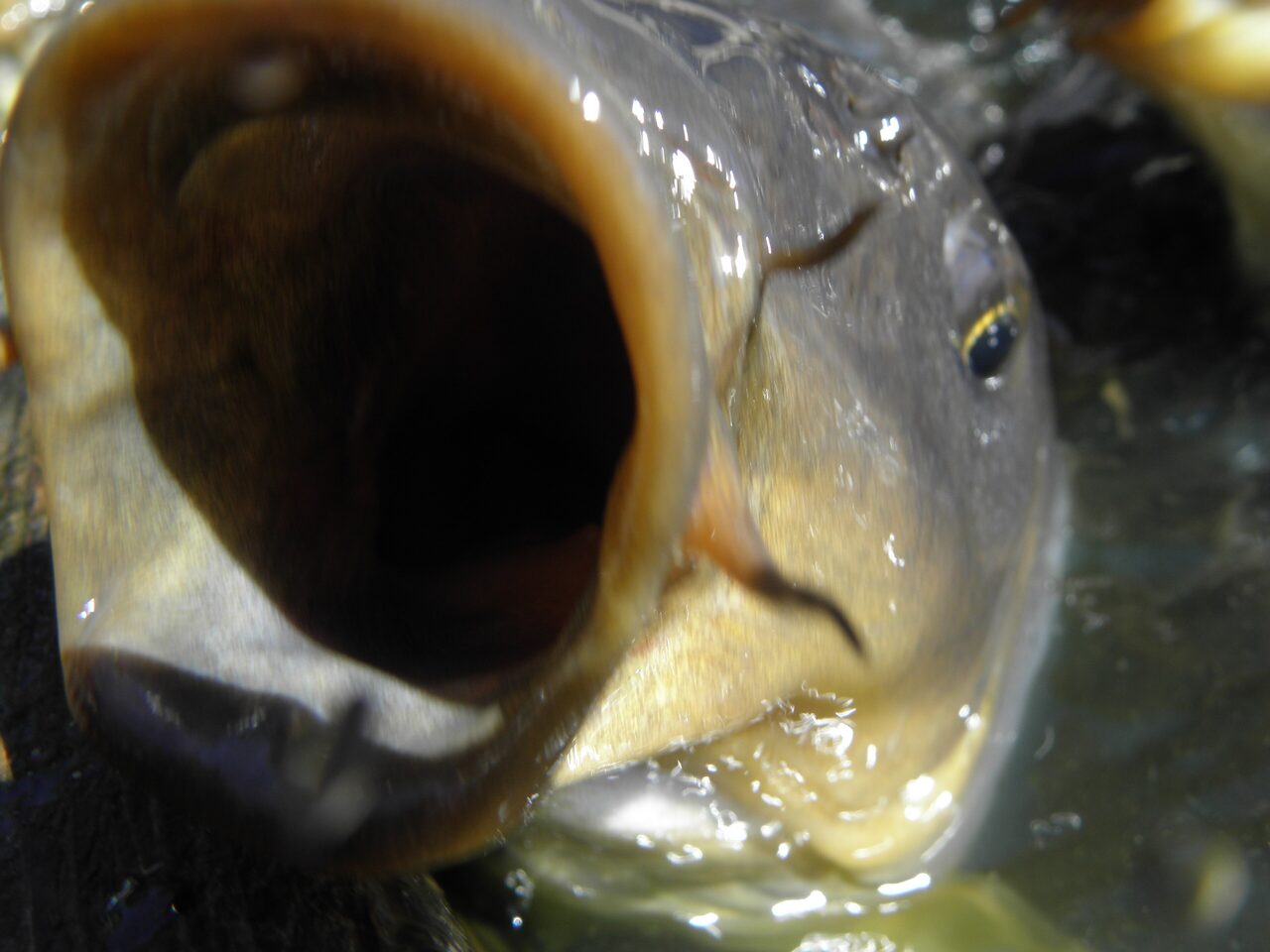
The barbels for real
The old plate hints at them; here you can see them properly - the four barbels around the fleshy, downturned mouth, the deep, muscular body and the golden sheen along the flanks that no crucian carp can match.
A stocked fish, and a wary one
The carp itself is not a threatened species here; it is a prized, carefully stocked fish. Two honest notes, though: because it spawns only in real warmth, it rarely reproduces reliably in a river like the Saale, so the stock rests on patient stocking. And its barbel-less lookalike, the crucian carp, is genuinely rare and protected year-round - so a fish without barbels should always be identified with care. Old, big carp deserve respect too: by working the bottom they help keep a water healthy. Predation by birds such as the cormoran or the grey heron is a factor for the smallest fish among several, not the whole story.
Biological and legal notes are a research draft; binding are the current ordinance and your permit. Rules & closed seasons.
In the kitchen
Firm, comparatively lean flesh - the classic Franconian festive fish, served blue, baked in beer batter or fried. Its season runs through the colder months, with Christmas and New Year the high points. Fish raised in clear, cool water taste clean, never muddy.
How to fish it: on the bottom - leger or method feeder, or a hair rig with a boilie, and sweetcorn as a classic bait. Fish the warm, slow, plant-rich bays and the water behind groynes, and pre-bait patiently. Return undersized fish under 35 cm, and any barbel-less lookalike.
Common questions about the carp
How do I recognise a carp for sure?
By its four barbels - two pairs at the corners of the fleshy, protrusible, downward-pointing mouth: a shorter front pair and a longer rear pair. Add the long dorsal fin with its inward-curved edge, and no other fish in the region can be confused with it.
Carp, crucian carp or gibel carp?
Look for the barbels. The carp always has four; the crucian carp and the gibel carp have none at all. So a barbel-less lookalike is not a carp - and since the crucian carp is protected year-round in Bavaria, any barbel-less fish should be identified with care and, in doubt, released gently.
Why are there scaled, mirror and leather carp?
They are all the very same fish, Cyprinus carpio; only the coat of scales differs. Centuries of pond breeding, much of it in monastery ponds, produced the fully scaled carp, the mirror carp with a few large shiny scales, and the almost bare leather carp.
Since when has the carp lived here?
It is not originally native to our rivers. It was brought north from the east in antiquity and then, through the Middle Ages, raised in the ponds of monasteries as a valued fish for the long fasting seasons. From that heritage it has long since become at home in the warm, quiet reaches.
How big and how old does a carp get?
Usually 35 to 90 centimetres; heavy fish pass a metre and 40 kilograms. In the Franconian Saale carp around 60 centimetres are on record. A carp is wary and long-lived - in good conditions it can reach several decades, which is part of why old, big fish deserve respect.
How do you fish for carp here?
On the bottom: a classic leger or method feeder, or a hair rig with a boilie, and sweetcorn is a time-honoured bait. Fish the warm, slow, plant-rich bays, behind groynes and in the impounded reaches, and pre-bait patiently - the carp is a cautious, clever fish.
Fish this stretch of the Saale
For the water at Wolfsmünster and Gräfendorf there are guest cards from a day ticket to a season permit, entirely without club membership.