Plate X · algae-grazer of the barbel zone
Nase
Chondrostoma nasus
Fish of the Year 1994 & 2020
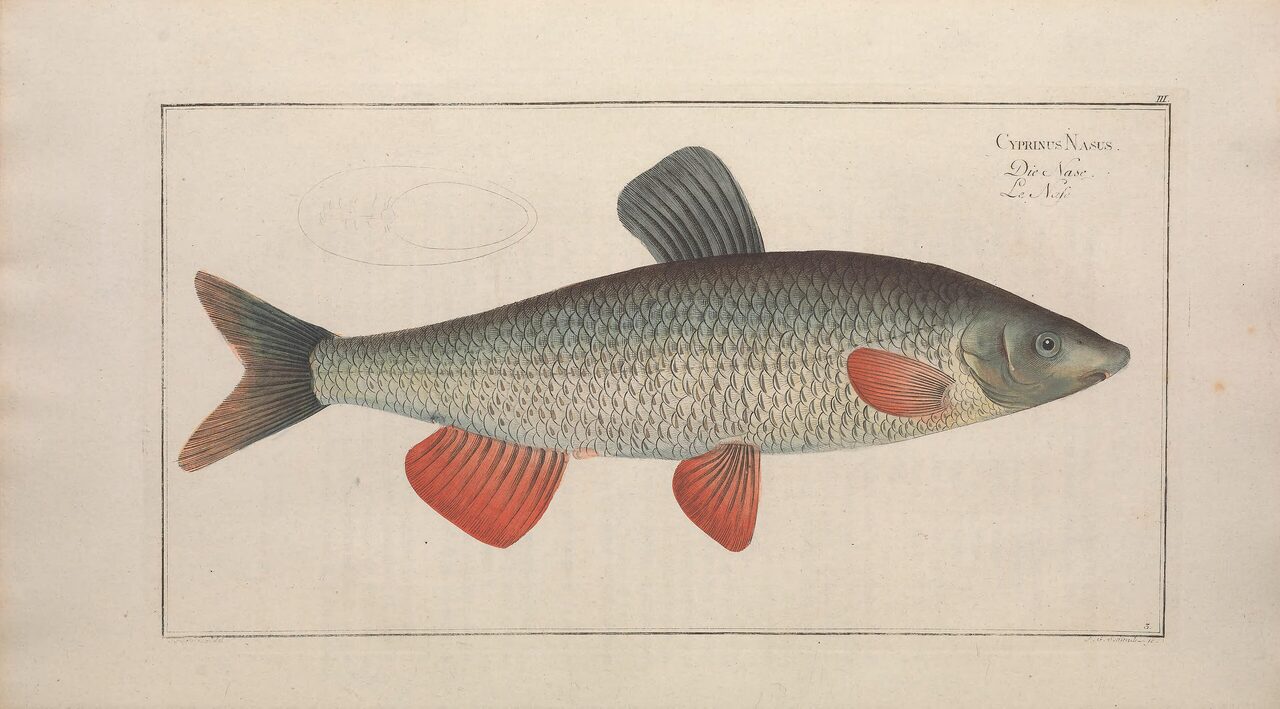
How to know it at once
- The protruding snout - a fleshy snout stands out over the mouth and gives the fish its name. The first thing you see.
- Underslung mouth, hard cross-lip with a horny, sharp-edged lower lip built for scraping. The surest anatomical sign.
- Deep-black belly lining - visible only when gutted, but then near-unmistakable.
- Reddish fins, silvery flanks on a slim, spindle-shaped body that flashes in the current.
The nase is a schooling fish of the barbel and grayling zones: oxygen-rich, fast-flowing reaches over hard, stony-gravelly ground, exactly the character of the Franconian Saale below the trout water. It holds near the bottom in the current, usually in company with barbel, grayling and chub.
She is a wanderer at heart: in spring the shoals set off far upstream to spawn over clean gravel, an old rhythm the region works hard to give back to her.
- no barbels at all
- hard, horny cross-lip
- black belly lining
- four barbels
- soft, fleshy lips
- pale belly lining
Rule of thumb: no barbels and a hard lip mean nase.
Keeper of the gravel
No other fish here works quite like the nase. With the hard, sharp lip beneath its snout it scrapes the film of algae from stone after stone, and in doing so it keeps the whole river bed clean, priceless work that goes almost unseen.
The nase is a specialist grazer. Its diet is the „aufwuchs“, the living film of algae and diatoms that coats stones and gravel, which it rasps away with that horny lip. Where the nase feeds, the stones stay clean and open.
That is more than tidiness. Left to grow unchecked, algae die back and their decay draws oxygen out of the water, which can harm every fish in the reach. By keeping the gravel clear, the nase quietly looks after spawning beds and river bed alike.
What makes the nase special (here)
Few fish tell the story of the Franconian Saale as plainly as the nase, from teeming abundance to near loss and, slowly, back again.
- once The spitter ride In vast shoals the nase ran up the Main and the Saale to the gravel banks. People scooped them out with willow baskets; „spitter“ they called the fish, for the way it spits up its food after the catch.
- from 1939 The routes break off As the Main was engineered and the weir at Gräfendorf went up, the migrating shoals lost their way to the spawning gravel. The great run faded, and the nase grew scarce.
- since the 1990s The comeback The nase became the leading fish of stocking on the lower Saale. Year after year young nase go back in, and new fish passes at Herschfeld, the Neumühle and Schaippach reopen the old routes.
- 2020 Fish of the Year The honour put the nase in the spotlight, standing for clean, connected, living rivers, a role it had already carried once, back in 1994.
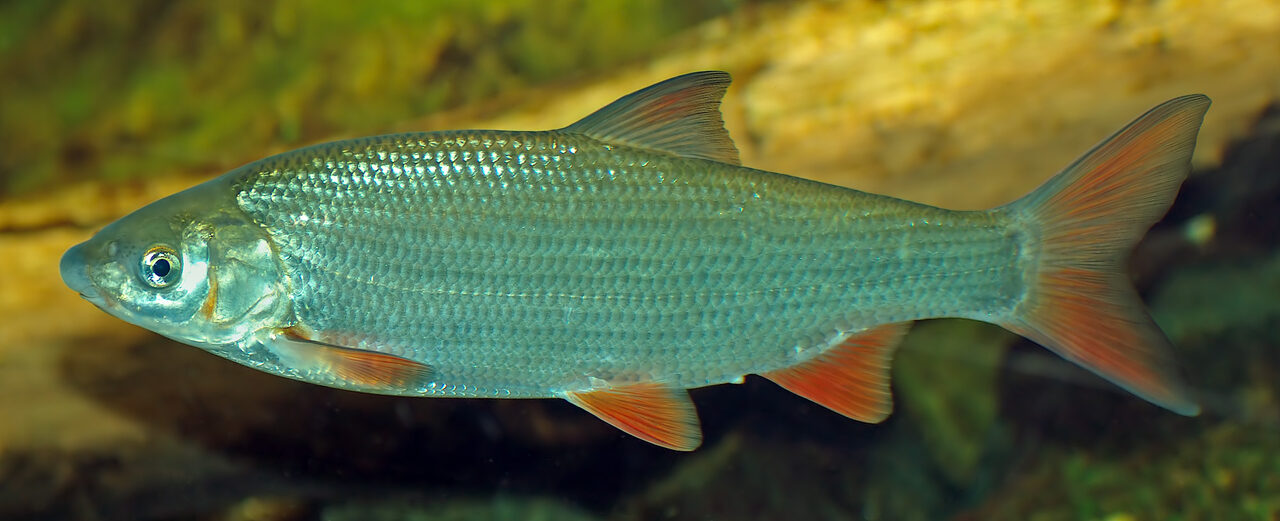
The snout for real
The old plate hints at it; here you can see it properly, that fleshy snout set forward over the underslung mouth, and the silvery flanks with the faint reddish glow in the fins that flash when the fish turns in the current.
A fish that needs open rivers
The nase is listed as strongly endangered on Bavaria's Red List. As a migratory fish it needs connected rivers and clean gravel to spawn, and both have become scarce: weirs and river works cut the old spawning routes, and silt settles over the gravel beds. Predation by birds such as the cormorant is named too, though experienced river keepers stress it is one factor among several, not the sole cause. That is exactly why the region invests so much in stocking and fish passes.
Local note: Population under threat; locally the nase is protected more strictly than required by law – the permit is binding.
Biological and legal notes are a research draft; binding are the current ordinance and your permit. Rules & closed seasons.
In the kitchen
Honestly, not a food fish of first choice: the flesh is very bony and rather soft and mild. Long ago it was eaten as a cheap „meadow fish“ and turned into skewered fish for market, but today, given how threatened it is, the nase is best admired and released.
How it is fished: traditionally with a light float or feeder near the bottom, small bundles of maggots as the top bait, and neutral rather than sweet flavours, since sweetness tends to put nase off. But with its threat status and strict local protection, on most of our water the nase is a fish to release, not to target, and your permit says what applies.
Common questions about the nase
How do I recognise a nase for sure?
By the fleshy, protruding snout with the strongly underslung mouth beneath it, whose hard, horny lower lip scrapes algae off the stones. If you ever open one, the belly lining is a striking, deep black, a near-unmistakable sign that no lookalike shares.
Nase or barbel?
Check the mouth. The barbel has four barbels and soft, fleshy lips; the nase has no barbels at all and a hard, horny cross-lip. They share the same fast gravel runs, so it is worth a second look, and the black belly lining settles it for good.
Why is the nase nicknamed the „spitter“?
Because after being caught it spits up part of its food. Its huge old spawning runs upstream to the gravel banks were once called the „spitter ride“, when the fish moved up the Main and the Saale in vast shoals.
Why has the nase become so rare?
It is a migratory fish that needs open rivers and clean gravel to spawn on. Weirs and river works cut its old spawning routes, and silt and lost gravel beds do the rest. Predation by birds such as the cormorant is named too, but experienced river keepers see it as one factor among several, not the sole cause.
May I keep a nase?
Better not. The nase is on Bavaria's Red List; there is a closed season from 1 March to 30 April and a minimum size, and locally it is protected more strictly still. On most of our water it is admired and released, and your permit is what binds.
Why is the nase so valuable to the river?
As it grazes, it keeps the stones and gravel clean of algae. Left unchecked, dying algae rob the water of oxygen, which can harm every fish; by keeping the river bed clear, the nase quietly looks after the whole community.
Fish this stretch of the Saale
For the water at Wolfsmünster and Gräfendorf there are guest cards from a day ticket to a season permit, entirely without club membership.