Plate XI · character fish of the quiet weedy zones
Tench
Tinca tinca
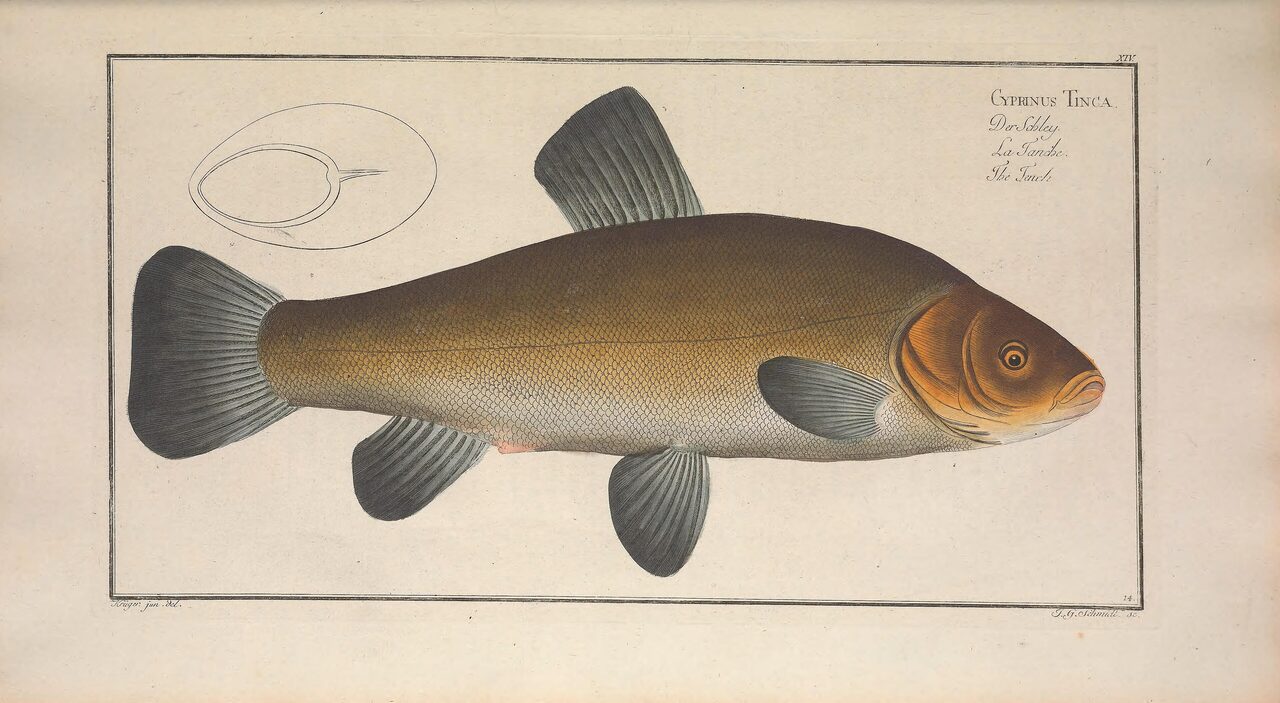
How to know it at once
- A tiny red eye — the small, glowing red-orange iris. The single most striking quick sign.
- Thick, slimy skin with minute scales set deep in a slippery, leathery hide.
- Just one pair of barbels — two short whiskers in the corners of the mouth. The carp has four.
- Rounded fins, high tail wrist — every fin softly rounded, the base of the tail strikingly powerful.
The tench is a stocky, dark olive-green member of the carp family, a sociable bottom fish of quiet, warm, weedy water. In the Franconian Saale it avoids the fast barbel and grayling runs and holds in the calm, plant-rich corners: old meanders, groyne fields, still bays and reedy margins, grubbing in the soft mud at dawn and dusk.
She is famously tough: of all the coarse fish the tench asks least of the water, coping with warmth and low oxygen where finer fish give up. Her olive coat with its brassy shimmer makes her easy to overlook, until that small red eye gives her away.
- small red eye
- only two barbels (one pair)
- short, rounded dorsal fin
- eye not strikingly red
- four barbels (two pairs)
- very long dorsal fin
Rule of thumb: count the barbels — two mean tench, four mean carp.
The tench, the doctor fish
Wrapped in a thick, healing coat of slime, the tench was known in old lore as the doctor fish. Other fish, so the tale ran, even the pike, would rub against it to heal their wounds, and would spare it in gratitude. The story is a legend, but the slime is real: it shields the tench, helps its own wounds close, and lets it thrive in warm, low-oxygen water where finer fish struggle.
What makes the tench special (here)
For generations the local fishing guilds have cared for the green tench, releasing young fish into the Main and the Franconian Saale year after year. In strong years they went in by the hundredweight, so the quiet backwaters keep their olive-green regular.
At one local fishing contest the cup for the biggest tench simply went unawarded, because not a single one had been caught. The anglers laughed that their tench were just too clever, and the joke has stuck ever since.
A feeding tench gives itself away: rising strings of little bubbles at the weed edge, where it grubs through the soft mud for snails and larvae. Old hands read these tench trails like a map to the next bite.
Of all the coarse fish the tench asks least of its water: it copes with warmth, low oxygen and even boggy, acidic corners, and can pass twenty years of age. Where others fade, the tench simply carries on.
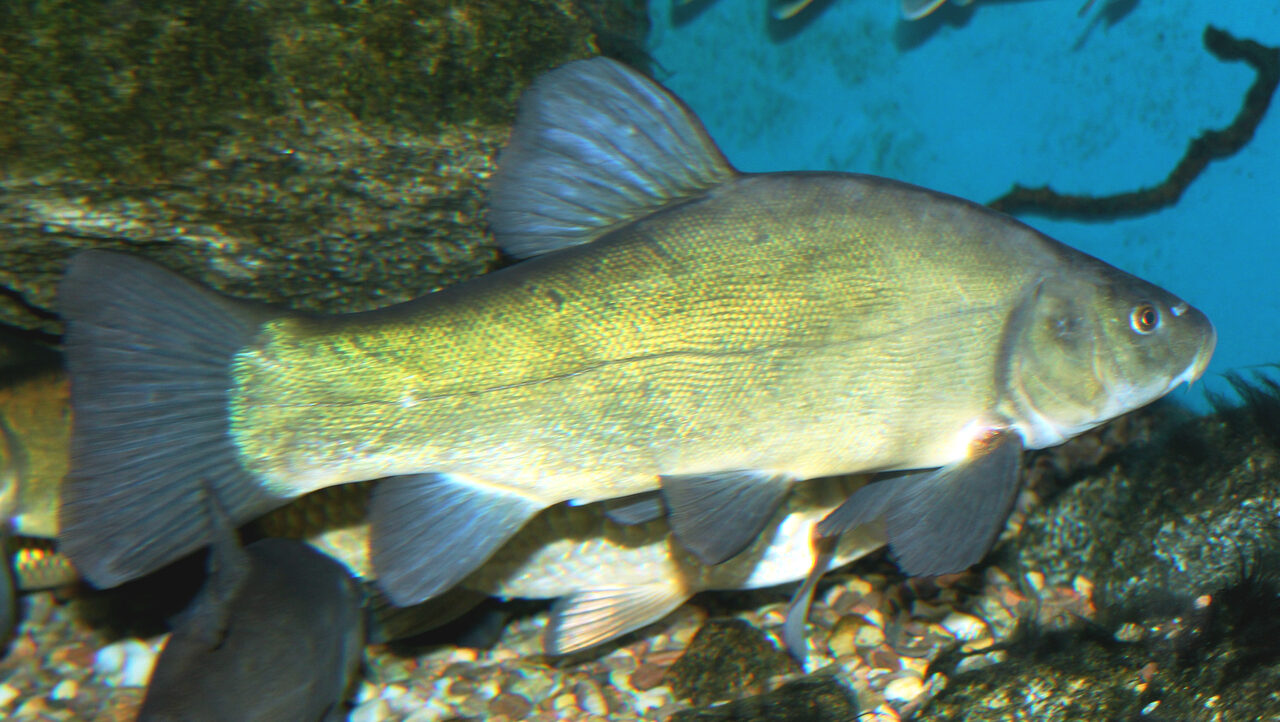
Olive, gold and that red eye
The old plate only hints at it; on the living fish you can see it properly — the dark olive back with its brassy shimmer, the thick, glistening skin that names the tench, and that small, unmistakable red eye set high in the head.
Not endangered, but not left alone
As a species the tench is not considered endangered, and it is at home across still and slow waters. Locally it still needs a hand: as the Main and the Saale have grown clearer, this cover-loving fish is more exposed to sight-hunting predators such as the asp, and birds like the cormorant take their share too, fairly named as one factor among several. That is why the guilds keep stocking young tench, mostly in spring, so the fish get a fair start.
Biological and legal notes are a research draft; binding are the current ordinance and your permit. Rules & closed seasons.
In the kitchen
White, firm, low-fat, low-bone flesh with a fine, slightly nutty flavour, rated by many above the carp. The classic is tench blue, poured over with hot vinegar and gently simmered. Just wash the slime off well beforehand; the tiny scales can stay on.
How to fish it: seek the quiet, weedy spots and fish the classic lift rig at the weed edge, or a feeder on soft mud with a small float boom so the bait does not sink in. Worm, maggot or corn at dawn and dusk works best.
Common questions about the tench
How do I recognise a tench for sure?
By the tiny, glowing red eye; the thick, very slimy skin with its minute scales; the single pair of barbels (two short whiskers in the corners of the mouth); and the rounded fins with a powerful tail wrist. All of these together are unmistakable.
Tench or carp?
Count the barbels: the tench has only two (one pair), the carp four (two pairs). The carp also carries a very long dorsal fin, while the tench's is short and rounded. The red eye and the extremely slimy, fine-scaled skin settle it in favour of the tench.
Why is the tench called the doctor fish?
Because of its thick coat of slime. In old lore other fish were said to rub against the tench to heal their wounds, and to spare it in gratitude. The tale is a legend, but the slime is real and truly protects the fish.
Where and how do I catch tench in the Saale?
In the quiet, weedy corners: old meanders, groyne fields, reed and lily edges. Classically with the lift rig at the weed edge, or a feeder on soft mud, baited with worm, maggot or corn, best at dawn and dusk. Mind the closed season.
How big and how old does a tench get?
Usually 20 to 40 centimetres, in rare cases up to about 65 to 70 centimetres and around seven kilograms. It is remarkably tough, copes with warm, low-oxygen water, and can pass twenty years of age.
Male or female tench?
Look at the pelvic fins: males have markedly enlarged, spoon-shaped pelvic fins, females smaller and slimmer ones. In grown fish it is a very reliable sign.
Fish this stretch of the Saale
For the water at Wolfsmünster and Gräfendorf there are guest cards from a day ticket to a season permit, entirely without club membership.