Plate XII · our only freshwater cod
Burbot
Lota lota
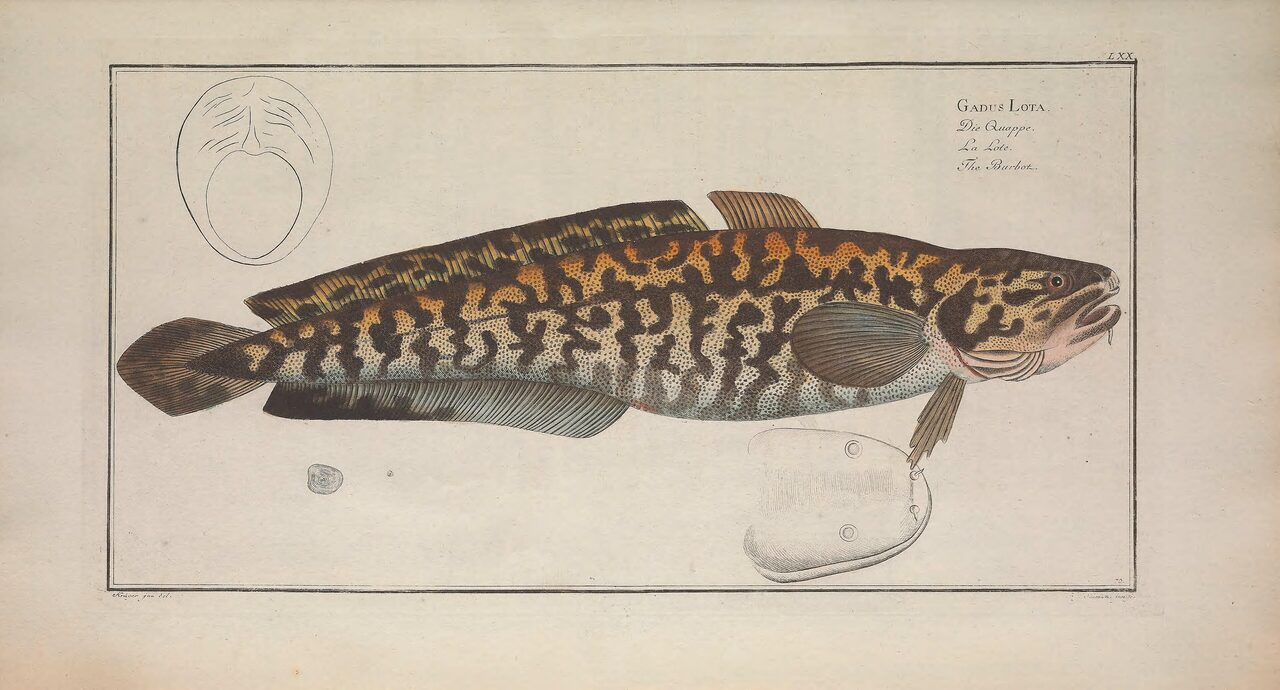
How to know it at once
- A single chin barbel - one long feeler in the middle of the lower jaw. The safest sign of all.
- Marbled, snake-like body with tiny embedded scales and a very slimy skin.
- Two dorsal fins - the second very long, with a long anal fin, both reaching close to the rounded tail.
- Broad, flat head with a wide, slightly underslung mouth.
The burbot, known here also as Quappe or Aalrutte, is something quite unique: the only purely freshwater relative of the cod in Central Europe - our own freshwater cod. It is a nocturnal cold-water bottom fish that sleeps through the summer heat and only truly comes alive as autumn cools the water. In the Franconian Saale it holds close to the bottom by structure: stone packing and groynes, deep pools, and the reaches below weirs and bridges where the ground is hard.
Its great moment comes when almost every other fish has long gone quiet: in the depths of winter, in icy water, it goes hunting and, colder still, spawns.
- one long chin barbel
- dark marbled skin
- two dorsal fins
- no barbel at all
- plain, unmarbled body
- one continuous fin seam
Rule of thumb: one chin barbel and marbled skin mean burbot. Six barbels would make it a catfish.
The fish that spawns under the ice
Almost every native fish slows to a standstill in winter. The burbot turns that rhythm upside down. It is a true cold-water fish: in high summer it rests, all but motionless, in the cool; only when the water chills does it wake, feed hungrily and set off to spawn - often beneath a lid of ice, at barely above freezing.
- Summer The long rest In the warmth the burbot lies dormant, tucked away in the cool depths, barely feeding.
- Autumn Waking to the cold As the water drops below about ten degrees it comes alive and feeds hard by night, building reserves.
- Dec – Feb Spawning under ice In the coldest weeks it spawns over gravel, its eggs drifting semi-buoyant in the near-frozen water.
What makes the burbot special (here)
Every other cod lives in the sea; the burbot is the single one that spends its whole life in fresh water. In the Saale it is a rare, quietly treasured guest - a saltwater family's one river-dweller.
Burbot mostly run 30 to 60 centimetres here, yet in the Saale and its side stream, the Schondra, near Gräfendorf a burbot of around 70 centimetres has been landed - a real event for such an elusive fish.
The burbot was named Fish of the Year 2002 - a call to remember a shy winter fish that suffers wherever rivers are dammed and its spawning runs are cut off.
Where the water grew cleaner, the burbot came back: as a cold, oxygen-loving fish it is a fine sign of a healthy river, and careful stocking of young fish has helped it hold on in the Saale.
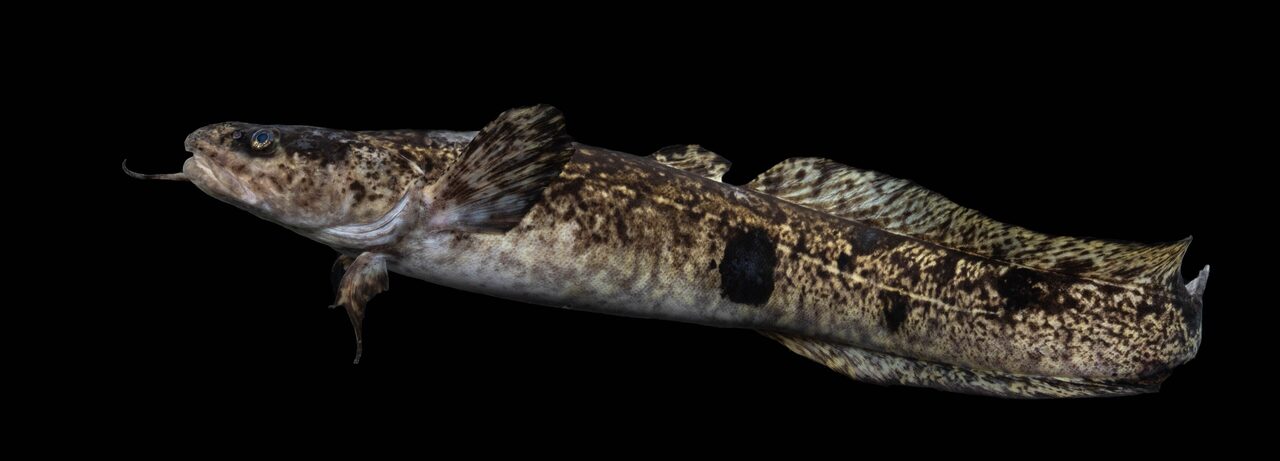
The marbling for real
The old plate hints at the pattern; on the living fish you see it properly - the dark, cloud-like marbling that camouflages the burbot against gravel and stone, the long second dorsal and anal fins, and the one soft feeler under the chin.
A winter fish under pressure
Across Germany the burbot has declined and counts as at risk. Its winter spawning run pushes upstream to gravelly reaches, and weirs and small hydropower stations cut those runs short; warming water, silted spawning beds and poorer water quality weigh on it too. Predation by birds such as the cormorant and the grey heron is named as well, though experienced conservationists stress it is one factor among several, not the sole cause. Where the river is kept clean and cool and its runs are open, the burbot can hold on.
Biological and legal notes are a research draft; binding are the current ordinance and your permit. Rules & closed seasons.
In the kitchen
Firm, white, lean and low in bones, with a fine, slightly sweet taste - and, as with its sea cousins, the large, fat-rich liver is a prized delicacy. It is best used very fresh, as the flesh loses quality quickly after freezing. Given the fragile stock, take sparingly.
How to fish it: cold winter nights from November to February, on a simple bottom rig with strongly scented bait such as a bunch of lobworms or a fish strip. Note: although the state sets no closed season, a local winter close may protect the spawners - the permit is binding.
Common questions about the burbot
What makes the burbot so special?
It is the only purely freshwater member of the cod family in Central Europe - our own little freshwater cod. Every other cod, from haddock to pollock, lives in the sea. That, plus its winter habits, makes it unlike any other fish in the Saale.
Why does the burbot spawn in the middle of winter?
It is a true cold-water fish. In summer heat it lies almost dormant; only as the water cools does it come alive, feeds hard and spawns in the coldest weeks of the year, roughly December to February, often under a sheet of ice at barely half a degree to four degrees.
Burbot, eel or catfish - how do I tell them apart?
The burbot has one long chin barbel, a marbled snake-like body and two dorsal fins. The eel has no barbel at all and a single fin seam running round the tail. The catfish has six barbels, two of them very long, and grows far bigger.
When and how do you fish for burbot?
It is a winter fish: from November to February, after dark, on a simple bottom rig with strongly scented bait such as a bunch of lobworms or a fish strip. Cold, raw, uncomfortable nights are the best of all.
Why has the burbot become rare?
Its winter spawning run pushes upstream to gravelly reaches, and weirs and small hydropower stations cut those runs short. Warming water, silted beds and poorer water quality weigh on it too; predation is named as well, though it is one factor among several, not the sole cause.
Can you eat the burbot?
Yes - firm, white, lean and low in bones, with a fine, slightly sweet taste, and its large, fat-rich liver is a real delicacy. Because the stock is fragile, though, take sparingly and follow the local rules, which may protect it in the spawning season.
Fish this stretch of the Saale
For the water at Wolfsmünster and Gräfendorf there are guest cards from a day ticket to a season permit, entirely without club membership.