Plate XIV · bottom fish and gauge of clean water
Bullhead
Cottus gobio
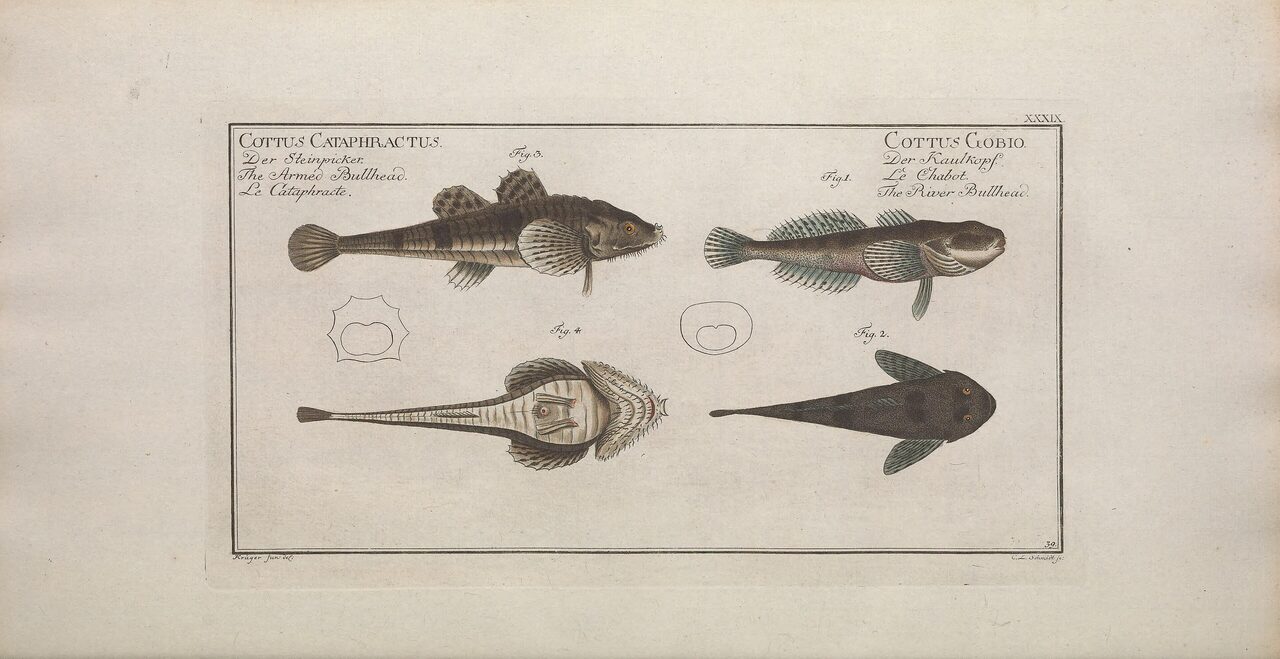
How to know it at once
- Broad, flat, frog-like head — oversized for the body, with a wide mouth and high-set eyes. The safest sign.
- Huge, fan-shaped pectoral fins spread out like little sails — it stands and pushes off on them.
- Scaleless, slippery skin — naked but for the lateral line, marbled grey-brown for camouflage.
- No barbels — and a small spine on each gill cover; mind it when you handle the fish.
The bullhead is a character fish of the trout and grayling zone: the cool, fast, oxygen-rich upper reaches over stone and gravel. It needs a living bed of gaps and cavities between the stones, where it hides by day and where it spawns. Barely a hand long, it belongs to the same clear headwaters and tributaries as the brown trout — above all the Schondra.
By day she sits pressed into the substrate, all but invisible; by night she goes hunting insect larvae and small crustaceans. She holds tight to her patch of gravel and never travels far — she simply cannot.
- no barbels at all
- broad, flat head
- scaleless, big fan fins
- six barbels round the mouth
- slim, rounded body
- ordinary small fins
Rule of thumb: any barbels at all mean it is not a bullhead — the similar gudgeon carries two and is clearly scaled.
A life on the gravel bed
Almost every other fish carries a swim bladder, a little internal float that lets it hover in the water. The bullhead has none. That single missing organ shapes its whole life: it cannot glide, so it hops, and it can only live where the bed is clean enough to hop across.
Watch a bullhead move and you understand it at once. It props itself on those outsized, fan-shaped pectoral fins, then flicks forward in a short, jerky hop and settles again — a walker on the river bed rather than a swimmer in the current. Even a small weir or a low drop is a wall it can never climb, which is why unbroken, connected water matters so much to it.
Grey and marbled, she melts into the stones so completely that you can look straight at her and miss her. And she is choosy to the point of being a living gauge: she settles only where the water stays cool, oxygen-rich and truly clean. Find a bullhead and you have found clean water — no test kit required.
What makes the bullhead special (here)
Along a single seven-hundred-metre reach of the cool Schondra, a stock survey once counted a dozen bullheads — swimming shoulder to shoulder with brown trout, grayling and eel. The little bullhead keeps the very best company.
At the height of summer the Schondra measured barely fourteen degrees. That steady cold is exactly what the bullhead needs; where trout waters warm and silt, she is among the first to disappear.
In early spring the male hollows out a nook beneath a flat stone. The female sticks her eggs to its underside, and he stands guard for weeks, fanning fresh water over the clutch until the young hatch.
Groppe, miller's thumb, Kaulkopf, Dickkopf — nearly every name winks at that broad head, and in the Franconian uplands people even call it Kaulhaaz. The name Mühlkoppe recalls the days when it lived in every mill brook.
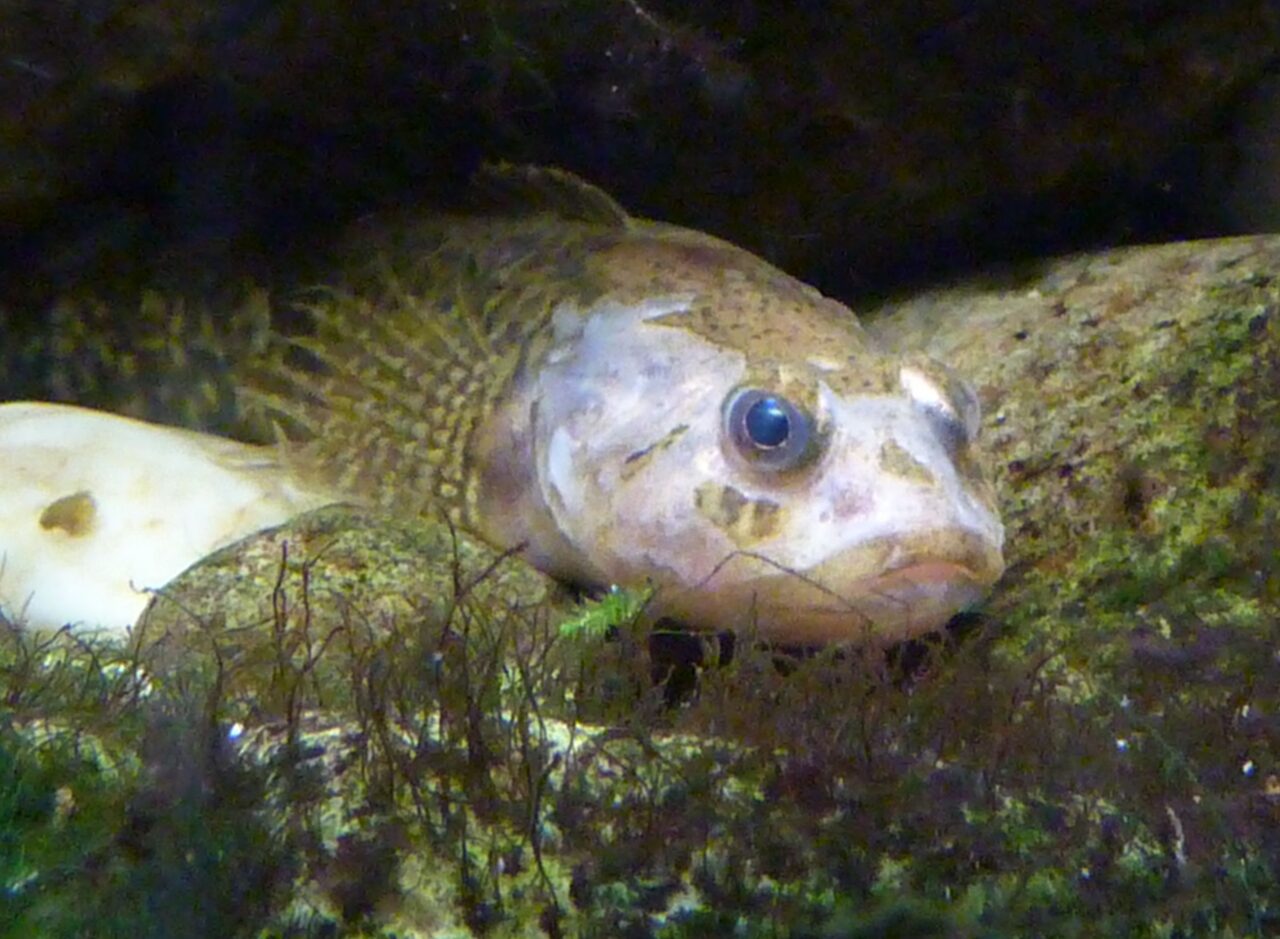
The camouflage in the flesh
Here you see what makes her nearly invisible: the broad, flattened head, the marbled grey-brown skin that copies the stones exactly, and those big pectoral fins spread wide beneath her like little props. Set her on a bed of gravel and she all but vanishes.
A small fish that asks a lot
The bullhead is a protected species, listed in Annex II of the European Habitats Directive, and on regional Red Lists it counts among the threatened. Its troubles are man-made: river barriers cut off a fish that cannot climb even a low weir, silt clogs the gaps between the stones where it hides and spawns, and pollutants hit a creature that only tolerates clean water. Bird predation is sometimes named too, but for so hidden a bottom fish it is at most one factor among several, not the heart of the matter.
Biological and legal notes are a research draft; binding are the current ordinance and your permit. Rules & closed seasons.
On the table?
Hardly. Barely a hand long, the bullhead is no table fish; long ago it was eaten at the mill brooks as the „miller's fish“, but today, protected and precious, it belongs in the water. It is no angling target either — at most an occasional by-catch.
If you catch one by accident: handle it gently with wet hands, mind the small spine on the gill cover, and slip it back among the stones without delay.
Local note: Strictly protected Habitats-Directive species and an indicator of clean water – please release carefully.
Common questions about the bullhead
Koppe, groppe or miller's thumb — why so many names?
They are all the same little fish. Nearly every name points at that broad, thick head: groppe, bullhead, miller's thumb. Along the mill brooks it was the miller's fish, and in the Franconian uplands people even call it Kaulhaaz.
How do I recognise a bullhead for sure?
By three things at once: a broad, flat, frog-like head, very large fan-shaped pectoral fins it stands on, and scaleless, slippery skin. Careful of the small spine on each gill cover when you handle it.
Bullhead or stone loach?
Look for barbels. The bullhead has none at all. The stone loach carries six barbels around its mouth and the gudgeon two, plus clear scales — so any barbels at all mean it is not a bullhead.
Why does the bullhead hop instead of swim?
Because it has no working swim bladder. Without that float it cannot hang in open water, so it rests on the bottom and moves in short, jerky hops across the gravel. Even small weirs and drops it cannot get past.
Is the bullhead protected — may I take one?
It is a protected Habitats-Directive species and in Bavaria has a closed season from 1 February to 30 April, with no minimum size. Local rules are often stricter, up to a full ban, and it is no table or sport fish anyway. If in doubt, release it carefully.
Why does the bullhead matter for clean water?
It is an indicator species: it only thrives in cool, oxygen-rich water of quality class two or better. Where the bullhead lives, the water is genuinely clean — in the Schondra it shares that clear water with the brown trout and the freshwater pearl mussel.
Fish this stretch of the Saale
For the water at Wolfsmünster and Gräfendorf there are guest cards from a day ticket to a season permit, entirely without club membership.